How to Remove Black Mould Safely (Without Spreading It)
As an Amazon Associate we earn from qualifying purchases. Some links on this page are affiliate links, which means we may earn a small commission if you make a purchase.
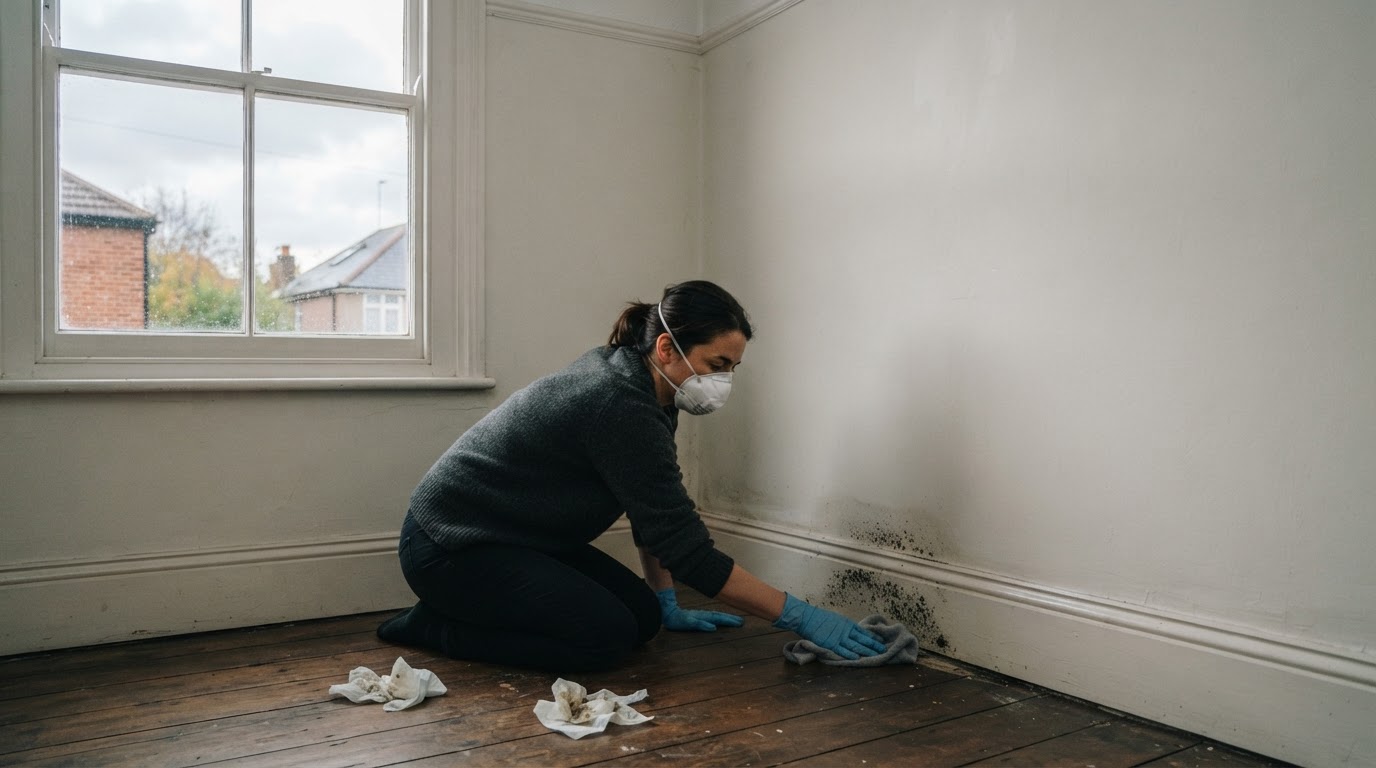
Most people who find black mould on their walls reach straight for the bleach. The logic seems sound: scrub it off, add a bit of elbow grease, job sorted. Except the job isn’t the mould on the wall — it’s the millions of spores you just released into every other room in the house. The stain on the plaster is the visible problem. The spores in the air are the real one, and almost every consumer guide skips the step that stops them spreading.
This article is for the reader who wants to clean mould safely and properly — not because it’s a “toxic mould crisis,” but because it’s usually condensation, and condensation is fixable. What most guides miss is the containment step before you touch anything. That’s what this piece is built around.
Is This a Job for a Professional?
Before you touch anything, ask yourself this: how big is the affected area, and what’s causing it? These two questions decide whether you should reach for a cloth or a phone number.
Call a professional — or at least get advice first — if the mould covers more than about a square metre, if it’s caused by a water leak or contaminated source, or if it’s working its way into the building structure (into timber, behind plaster, or coming up from below in a way that suggests rising damp rather than condensation). The UK Health and Safety Executive guidance on mould in workplaces specifies containment with sheeting for areas over 1m², and that threshold is a useful shorthand for domestic situations too. If you’re dealing with anything that size or larger, you need equipment and expertise that standard household products can’t provide.
There’s a health reason to step back too. NHS guidance advises against attempting DIY removal if you have asthma triggered by mould, or if anyone in the household is very young, older, or has a weakened immune system. This isn’t about alarm — it’s about matching the task to the person doing it.
The honest answer for most surface mould in a UK bathroom or bedroom corner is that it is a DIY task, provided you do it safely. The “safely” part is where most guides fall short.
Decision checklist — should you call someone?
- Is the mould caused by sewage, flooding, or a contaminated source? → Yes, call a professional.
- Is the affected area larger than roughly 1m²? → Consider a professional.
- Is the mould embedded in the building structure — timber, behind plaster, or coming up from the floor? → Get an independent survey before doing anything.
- Is anyone in the household asthmatic or immunocompromised? → Speak to a professional rather than DIY.
- Small area, surface only, no building fault suspected? → You can handle it safely with the right process below.
If you’re still unsure about the cause — whether it’s condensation, a leak, or something structural — download our free Damp & Mould Diagnosis Checklist before you spend money on either products or a contractor.
The Safe Removal Process
Here is the step that almost nobody mentions. Before you spray, scrub, or wipe anything, you seal the room. This is the most important action in the entire process, and it is missing from the vast majority of consumer guides.
When you disturb mould — by brushing, wiping, or spraying — spores become airborne. In a typical UK home with open-plan layouts, under-door gaps, and central heating creating upward air currents, those spores don’t stay in the bathroom. They travel. Sealing the affected room with plastic sheeting taped across the door frame, and placing a damp towel along the gap at the bottom of the door, traps spores in the work area. This is standard practice in professional mould remediation. It’s not complicated. It’s just almost never written down for householders.
Once the room is sealed, work through these steps in order:
- Seal the room — tape plastic sheeting across the door frame. Tuck a damp towel along the bottom gap.
- Put on PPE — rubber gloves, goggles without ventilation holes, and a mask that covers nose and mouth. Ordinary surgical masks are better than nothing but not ideal; a proper respirator mask (FFP2 or FFP3) is worth the small extra cost if you have any respiratory concerns.
- Do not brush or vacuum the mould — brushing releases spores from the surface into the air. Use a damp cloth to wipe it away gently.
- Open windows for ventilation — but keep internal doors shut. You want fresh air in, spores contained.
- Clean the surface — see the product section below for what works and what doesn’t.
- After cleaning — vacuum the room with a HEPA filter if you have one (it traps spores rather than redistributing them), then dispose of the cleaning cloth in a sealed bag.
- Let the room dry — moisture feeds mould. Once the surface is clean, keep the room ventilated until it’s fully dry.
The sequence matters. Contain first, then clean, then dry. Skip the first step and you clean one patch while spreading spores to every other room in the house.
What to Use: Bleach, Vinegar, or Natural Alternatives?
Once the room is sealed, the question becomes what to actually put on the mould. The honest answer is that the product matters less than most people assume — containment and fixing the underlying moisture are what actually solve the problem. But if you’re going to clean the surface, it helps to know what works and what the trade-offs are.
Bleach or washing-up liquid — effective for surface mould on hard, non-porous surfaces like tiles and glass. Bleach can release irritating fumes, particularly in a poorly ventilated room, and it doesn’t always reach deep into porous plaster — so the stain may disappear while the root remains. For a quick surface clean on bathroom tiles, it’s a reasonable option. For plaster or drywall, it has real limitations.
White vinegar — a natural antiseptic that, when applied full strength or diluted with one part water and left to sit for an hour, kills surface spores effectively. It’s gentler on respiratory health than bleach, which matters if you’re working without industrial-grade PPE. The smell is sharp but dissipates quickly with ventilation. Owners who’ve compared vinegar against branded mould removers on bathroom tiles generally find it competitive for light to moderate surface mould — and it’s a fraction of the price.
Tea tree oil — a natural antiseptic and disinfectant. Mix roughly a teaspoon with a cup of water, spray on, leave it, and wipe away. It’s effective and the smell is more pleasant than bleach. Worth noting: tea tree oil is toxic to pets, particularly dogs, so keep pets out of the room until it’s been wiped away and dried.
Fungicidal wash — the most thorough option for killing mould at the root, and the one gov.uk guidance specifically recommends over bleach for rented housing. These products require good ventilation. For household use, read the label carefully and follow it.
No cleaner will prevent the mould from returning if the underlying moisture problem isn’t fixed. A bleach scrub on a cold north-facing wall in a poorly ventilated flat will look great for about six weeks. Then the mould comes back, and this time it tends to be worse.
How to Stop It Coming Back
This is the part most guides treat as an afterthought, and it’s the part that actually matters long-term. Surface mould caused by condensation will return — every time — unless you change the conditions that created it. The cleaner you used is irrelevant. The moisture source is what needs addressing.
The practical steps are straightforward, and none of them require spending money on products:
- Run extractor fans when showering or cooking, and leave them on for at least 20 minutes afterwards.
- Open windows daily, even in winter — even a ten-minute cross-ventilation makes a difference.
- Warm the home consistently rather than letting walls cool right down overnight. Cold walls are what condensation settles on.
- Avoid drying clothes indoors on radiators wherever possible. A typical load of laundry releases around two litres of water into the air. If you must dry clothes inside, do it in a bathroom with the extractor fan on and the door closed.
- Check that trickle vents on double-glazed windows are open. Sealing a home completely for energy efficiency has changed the ventilation patterns in UK houses dramatically over the past twenty years.
If you’ve done all of this and still have condensation problems — particularly in a room that stays cold — a dehumidifier is worth considering. Not as a cure, but as a tool for managing moisture in rooms that genuinely struggle to ventilate. For a guide to choosing the right size and type, see our dehumidifier decision guide .
If you’re renting and the mould keeps coming back despite your best efforts, the issue may be with the property itself — inadequate ventilation, a hidden leak, or insufficient heating. That’s your landlord’s responsibility. Report it in writing, keep a copy, and if the problem is serious and the landlord doesn’t act, contact your local council’s environmental health team. For a full breakdown of tenant rights and the correct reporting route, see our landlord responsibilities guide .
Frequently Asked Questions
Is black mould toxic?
The NHS does not use the term “toxic black mould,” and this site doesn’t either — it’s a phrase that belongs to alarmist content, not official UK guidance. NHS guidance notes that mould spores can cause or worsen respiratory problems, trigger asthma, and cause allergic reactions, with higher risk for children, older people, and those with weakened immunity. It’s not “toxic” in the sense of being poisonous if touched or inhaled in small amounts, but the spores are a genuine health concern, which is why safe removal matters. If you have asthma triggered by mould, NHS advice is to avoid cleaning it yourself and seek professional help.
Can I paint over mould?
No — not without cleaning it first. Anti-mould paints like Ronseal Anti-Mould Paint (paid link) or Dulux Easycare Bathroom (paid link) can help prevent regrowth on the surface, but they are a cosmetic fix, not a cure. If the underlying condensation or moisture problem isn’t resolved, mould will grow through the paint from behind, or around the edges. Buyers who report mould returning within weeks almost always had a moisture source that the paint couldn’t address. Clean the mould properly, fix the ventilation, then repaint if needed.
View on Amazon → (paid link)
What should I do if my landlord won’t fix it?
Report the problem in writing — email or letter, keep a copy. If you rent socially through a housing association or local authority, Awaab’s Law means there is now a legal duty to address serious damp and mould hazards within specific timeframes. In private renting, if the landlord doesn’t act, your local council’s environmental health team can intervene. They have powers to require the landlord to make repairs. You can also contact Shelter or Citizens Advice for free, independent guidance on your specific situation. Do not let the problem drift — document everything, in writing, from the start.
Mould Removal Product Comparison
| Product | Best For | Key Consideration |
|---|---|---|
| Bleach | Hard, non-porous surfaces (tiles, glass) | Doesn’t reach deep into porous plaster; releases irritating fumes |
| White Vinegar | Surface mould on tiles and walls | Natural antiseptic; gentler on respiratory health |
| Tea Tree Oil | Natural alternative | Toxic to pets; pleasant smell but requires drying time |
| Fungicidal Wash | Thorough root killing | Recommended by gov.uk for rented housing; requires ventilation |
| Detergent | General cleaning | Cost-effective; effective when combined with proper ventilation |
Where to Go From Here
The core of safe mould removal is three things: contain the spores before you start, clean the surface properly, and fix the underlying condensation problem so it doesn’t come back. The cleaning product matters less than most guides imply. The containment step matters more.
For a small patch of surface mould in a bathroom or bedroom — the kind that appears every winter and seems to come back no matter what you scrub with — the honest fix is ventilation, not a specialist product. If you’ve sealed the room, cleaned it with a mild detergent or vinegar, and the mould keeps returning, the question to ask isn’t which cleaner to buy next. It’s what’s keeping the walls cold and the air damp.
If you’re still working out whether what you’re seeing is condensation, rising damp, or something else entirely — download the free Damp & Mould Diagnosis Checklist . It’s the step before you spend money on anything, and it’s free.
Explore More Topics
Go deeper on specific topics:
- Does Vinegar Kill Mould? What Works Better on UK Walls
- Bleach vs Mould Spray vs HG Mould Remover: What Actually Works
- Removing Mould From Silicone, Grout and Window Seals
- Mould on Wallpaper, Curtains and Fabric: What’s Salvageable
- Protective Kit for Mould Removal: Mask, Gloves and When to Stop
- Why Mould Comes Back After You Clean It — and How to Stop It
Sources & Further Reading
As an Amazon Associate we earn from qualifying purchases.
Note: General guidance only. Always verify details with a qualified professional or official source.
Check Dulux Easycare Bathroom price → (paid link)