Bleach vs Mould Spray: Which Actually Works in UK Homes?
As an Amazon Associate we earn from qualifying purchases. This page contains affiliate links — if you buy through them, we earn a small commission at no extra cost to you.
You scrub the black mould off your bathroom ceiling, give it a thorough going over with bleach, and two weeks later it’s back in the same spot. It’s frustrating, but predictable. The reason isn’t that you didn’t scrub hard enough.
The difference between a product that works and one that doesn’t comes down to chemistry, specifically contact time: how long the active ingredient actually stays on the surface. That is the variable most people skip when they reach for the cheapest option on the shelf, and it’s why gel-formulation mould removers consistently outperform standard bleach spray on UK walls—even though they are both bleach-based.
Here’s what’s actually going on, and what genuinely fixes it.
Why Bleach Often Fails on UK Walls
Standard household bleach—sodium hypochlorite—kills surface mould by oxidising its cell proteins. That mechanism is real. But oxidisation only works if the chemical stays in contact with the mould long enough to do its job, and that’s where standard spray bottles fall short.
Bleach spray runs off vertical walls in seconds. You spray it, it drips straight down to the skirting board, and the mould at chest height has had perhaps ten seconds of exposure before the surface dries. The visible stain lightens—bleach is a bleach, after all—so it looks like it worked. But the spores beneath the surface are largely untouched, and they’ll germinate again as soon as the conditions return.
There’s a secondary problem with porous surfaces, which most UK internal walls are: plaster and grout absorb liquid. When bleach sits on a non-porous tile, it can do its job at the surface. When it hits bare plaster or old grout, it soaks in and concentrates at the surface layer rather than spreading—meaning it bleaches what it touches but doesn’t reach deep enough to kill the root. Some homeowners report that bleach can encourage mould to grow deeper into porous materials over time, as the moisture it introduces creates exactly the conditions mould thrives in.
The honest summary: bleach is a reasonable first response on hard, non-porous surfaces like ceramic tiles. On painted plaster, grout lines, or shower silicone, it often fails not because the chemistry is wrong, but because the delivery is.
The key variable isn’t the brand—it’s contact time. Standard spray gives seconds. Gel formulations give minutes. That difference determines whether the bleach actually kills the mould or just bleaches the stain.
The Gel-Formulation Advantage: How It Works
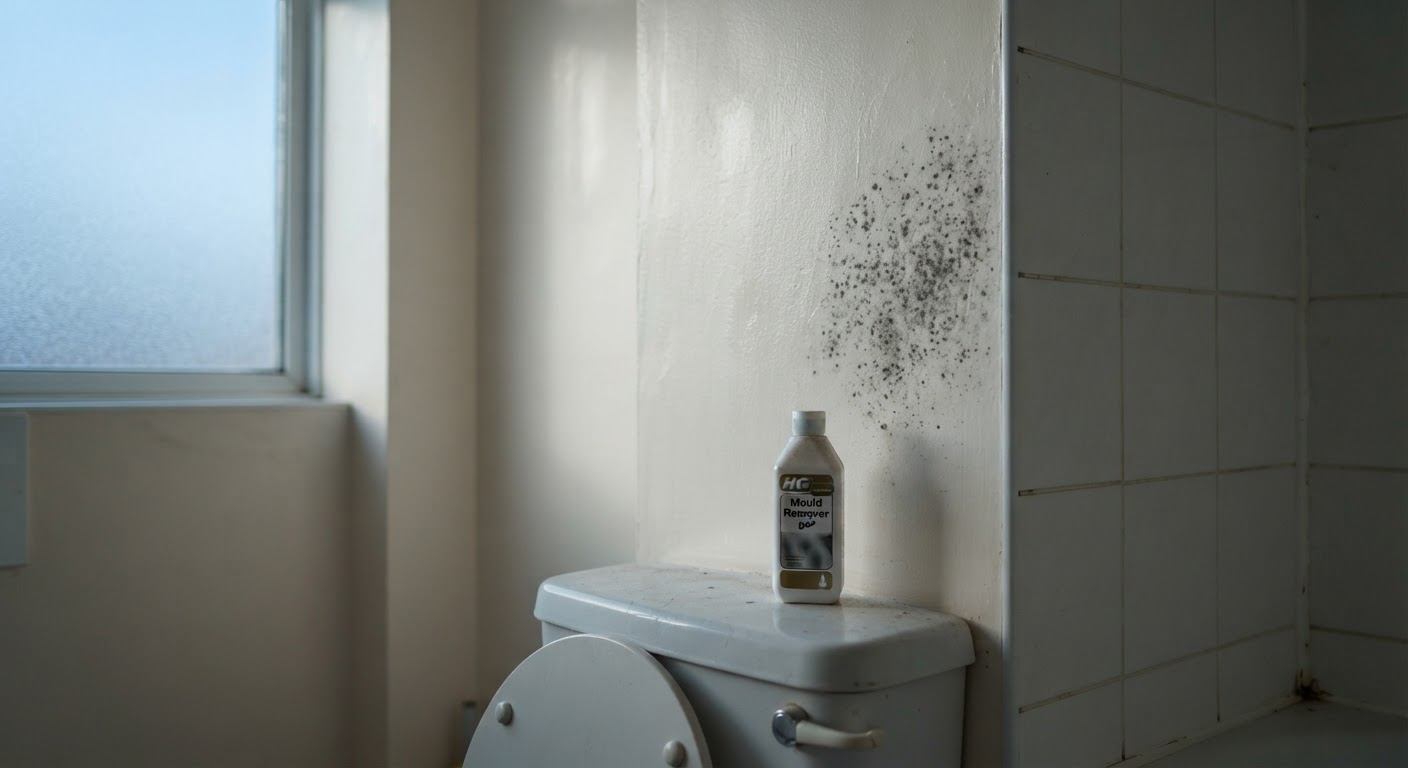
Gel-formulation mould removers—HG Mould Remover (paid link) is one of the best-known UK brands—solve the contact-time problem directly. The gel clings to vertical surfaces instead of running off, keeping the active ingredient in contact with the mould long enough to do proper work.
View on Amazon → (paid link)
That extended contact time is the mechanism that makes the difference. The gel sits on the surface, the sodium hypochlorite has time to penetrate beyond the top layer of spores, and the result is a cleaner that actually removes mould rather than just decolourising it.
UK homeowners who’ve used both standard bleach and a gel product tend to notice the difference on shower grout and silicone seals in particular—surfaces that are slightly porous and vertical. Owners who make the switch report that a single application is often enough, rather than needing repeated scrubbing. The trade-off is ventilation: gel removers have a strong bleach smell, and working in a poorly ventilated bathroom is unpleasant. Open a window, leave the door open, and give it time before you seal the room back up.
One thing worth stating plainly: no mould remover prevents regrowth. If the moisture source—condensation from poor ventilation, a leak, or a chronically cold wall—remains, the mould will come back. That’s not a product failure; it’s a moisture problem, and no spray bottle solves moisture.
Now you know what to look for—Get the Free Damp & Mould Diagnosis Checklist to confirm whether you’re dealing with condensation, a ventilation issue, or something that needs a different fix.
When to Replace the Caulk Instead of Cleaning
There’s a scenario where neither bleach nor gel mould remover is the right answer: when the mould has established itself within the shower caulk or silicone sealant itself, rather than just on the surface.
If the mould is sitting on top of the caulk, a thorough clean can work. If it’s grown into the body of the sealant—dark staining running through the whole bead—then the only thing that actually removes it is replacing the caulk. No chemical cleaner reaches into the body of silicone.
This isn’t a criticism of any particular product. It’s just physics: silicone sealant is a continuous polymer with no pores for liquid to penetrate. If the contamination is at depth, you need to cut the old bead out and apply a fresh one.
Replacing shower caulk is a straightforward DIY job. You’ll need a Stanley knife or caulk removal tool, some white spirit to clean residue, and a tube of mould-resistant silicone. It’s a bit of a faff, but it directly removes the contaminated material rather than fighting a losing chemical battle.
The honest trade-off here: replacement takes twenty minutes and costs a few pounds, versus repeated applications of cleaner that never quite sorts it. For a shower that’s been battling mould for months, replacement is usually the better call.
The Real Fix: Controlling the Moisture Source
None of the above—bleach, gel remover, or caulk replacement—is a permanent solution if the underlying moisture problem remains. The reason mould grows back isn’t that the products failed. It’s that the conditions that allowed it in the first place are still there.
NHS guidance on damp and mould in the home focuses on exactly this: improving ventilation, reducing indoor moisture, and repairing any leaks. Mould remover products can help make a bathroom look clean in the meantime, but they don’t change the humidity level, the airflow, or the temperature of the surfaces where condensation forms.
What does change those conditions? Practical steps that address the root cause:
Extractor fans that vent to the outside—not into a loft or a shared duct—remove moist air at source. Trickle vents in window frames allow background ventilation without draughts. Dehumidifiers pull excess moisture from the air in rooms that struggle to dry out. Simply being aware that every shower, every kettle, and every drying load of laundry adds moisture to the air—and ensuring that moisture has a way out—makes a significant difference over a season.
Anti-mould paint is sometimes sold as a solution to mouldy walls. It is not. It buys you a cleaner-looking surface for a while, but if the wall is cold because of poor insulation or if the room stays humid because of inadequate ventilation, the mould will grow through or around the paint just as it did before. Think of anti-mould paint as a temporary cosmetic measure at best, not a fix.
Mould Removal Product Comparison
| Feature | Standard Bleach Spray | Gel Mould Remover | Replacement Caulk |
|---|---|---|---|
| Contact Time | Seconds | Minutes | Permanent |
| Surface Suitability | Non-porous tiles | Vertical porous surfaces | Contaminated seals |
| Effectiveness on Stains | High | High | N/A |
| Moisture Control | None | None | None |
| Cost per Use | Low | Moderate | Low (one-off) |
Frequently Asked Questions
Is bleach or mould spray better for grout?
A mould spray with a gel formulation is generally better for grout on vertical surfaces, because it stays wet long enough to penetrate into the grout lines rather than running straight off. If the mould has worked its way deep into the grout itself, replacement may be necessary; grout is porous enough that contamination at depth cannot be reached by surface cleaning.
Can I use white vinegar instead of bleach?
White vinegar can kill surface mould and is a reasonable option for small, non-porous areas where you want to avoid strong bleach fumes. It doesn’t bleach the stain the way sodium hypochlorite does, so the black mark remains visible even after the mould is dead. It also won’t penetrate as deeply as a gel-formulation mould remover, so for anything beyond a light surface bloom, it is a less effective option.
How often should I clean mould if it keeps coming back?
If mould returns within weeks of cleaning, the honest answer is that the cleaning schedule isn’t the problem—the moisture situation is. Focus your effort on ventilation, extractor fan use, and reducing indoor humidity rather than cleaning more often. Once the room dries properly between uses, cleaning becomes occasional maintenance rather than a weekly battle.
Taking the Next Step
The picture should be clearer now. Gel-formulation mould removers work better than standard bleach spray on vertical, semi-porous surfaces—not because the chemistry is dramatically different, but because they stay wet long enough to actually work. Where mould has grown into shower caulk or silicone, replacement is the simpler, cheaper, and more effective solution. None of it holds unless you deal with the moisture source: ventilation, extractor fans, and awareness of what you’re adding to the air indoors.
If you’re not sure whether you’re dealing with condensation, a ventilation gap, or something that needs a different approach—that is worth sorting before you spend anything on products.
Get the Free Damp & Mould Diagnosis Checklist to work through the key questions and narrow down what is actually driving the problem in your home.
Related Guides
For a complete overview, see our How to Remove Black Mould From Walls Safely .
Sources & Further Reading
As an Amazon Associate we earn from qualifying purchases.
Note: General guidance only, verify details with a qualified professional or official source.