What to Do If Your Landlord Ignores Mould: Council and Legal Routes

You’ve emailed three times, sent photos, and described the black patches spreading across the bedroom ceiling—and your landlord has replied with, “it’s just condensation, open a window.” That response is common enough to be a template. It is also, in most cases, legally wrong. The Homes (Fitness for Human Habitation) Act 2018 requires landlords to keep rental properties safe, healthy, and free from damp that affects the fabric of the building or the tenant’s health. If your landlord has ignored written reports of mould, your next step is not a solicitor. It is your local council’s environmental health department—and that route has more teeth than most tenants realise.
Here is the process, step by step.
Start With the Paper Trail
Before you contact anyone official, ensure you have given your landlord a proper chance to respond in writing. This is a legal prerequisite for most enforcement actions. Always use email or text rather than phone calls, because you need a record that exists independently of your memory.
Your written report should include:
- The specific location of the mould (which room, which wall, which ceiling)
- When you first noticed it and how it has developed
- Photos taken on your phone with the date stamp visible
- A reference to the Homes (Fitness for Human Habitation) Act 2018 and the landlord’s legal duty to keep the property free from damp hazards
- A request for remedial action within a reasonable timeframe (14 days is standard)
Keep a copy of every message you send. If you have been emailing or texting already, forward those to yourself or print them out. The tenant who cc’d the council into her email before it escalated is the tenant whose landlord acted—not because the law changed, but because the paper trail made it harder to ignore.
If you are not sure whether what you are seeing is condensation or something more structural, our guide to How to Tell If It’s Condensation or Damp explains the practical difference in a few minutes.
The Council Route: Your Most Powerful Option
This is the step most tenants skip. Your local council’s Environmental Health (or Private Housing) department has legal powers under Part 1 of the Housing Act 2004 that go significantly further than a strongly worded email.
The mechanism is the Housing Health and Safety Rating System (HHSRS). Under Section 79 of the Housing Act 2004, damp and mould is treated as a Category 1 or Category 2 hazard—not just a cosmetic problem. A Category 1 hazard means there is a serious risk to health, and the council is legally required to act.
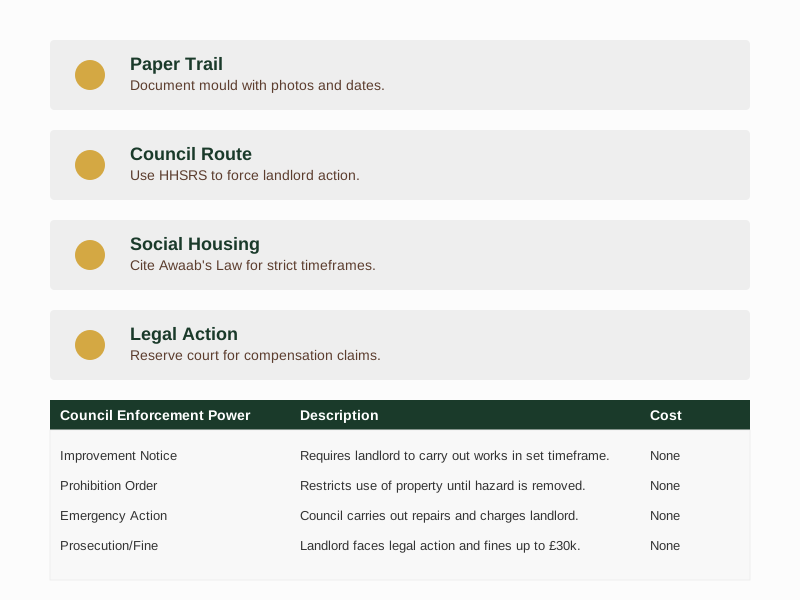
The HHSRS gives the council four specific powers it can use against a non-responsive landlord:
- Serve an Improvement Notice requiring the landlord to carry out specified works within a set timeframe
- Issue a Prohibition Order restricting or banning use of all or part of the property until the hazard is removed
- Carry out Emergency Remedial Action—do the repair work themselves and charge the landlord
- In the most serious cases, prosecute or impose a fine of up to £40,000 if the landlord fails to comply with an Improvement Notice (raised from £30,000 under the Renters’ Rights Act 2025, in force since May 2026)
None of this costs you a penny. The council acts in the public interest on your behalf.
The reason the council route wins over legal action for most private tenants comes down to speed and cost. A solicitor and county court claim will set you back in fees and take months to reach a hearing. The council can inspect within weeks and serve a notice that carries immediate legal consequences for the landlord. Legal action is better suited to compensation claims after the fact; it is not the right tool for forcing repairs to happen quickly.
The honest caveat is that “weeks” is the realistic timeframe, not days. Councils are stretched, and an inspection won’t happen overnight. But once the notice is served, the clock starts running on the landlord—and that is exactly what most landlords respond to.
If the council inspects and agrees the property has a Category 1 hazard, the landlord is responsible, period. Don’t let anyone tell you the council will blame condensation or “lifestyle”—the HHSRS assessment looks at the property itself, not the tenant.
If you are dealing with a social landlord rather than a private one, there is a parallel route worth knowing about: Tenant Rights in Social Housing .
The Social Landlord Route: Awaab’s Law
If your landlord is a council or housing association, the process has an additional layer. You should still use the council’s environmental health route—it applies regardless of tenure. But social housing tenants also have access to their landlord’s own complaints procedure, and from October 2025, that process comes with significantly sharper teeth.
Awaab’s Law, named following the tragic death of two-year-old Awaab Ishak from prolonged exposure to mould in a housing association property, places strict legal timeframes on social landlords to investigate and fix damp and mould hazards. The Housing Ombudsman, who oversees complaints against social landlords, has published learning resources making clear that this is not optional or discretionary—it is a legal duty.
The escalation path for social tenants:
- Report through your landlord’s formal complaints procedure—get a reference number and a written response
- If the landlord fails to act within the Awaab’s Law timeframe, escalate to the Housing Ombudsman—this is a free service with real authority to order compensation and require action
Social landlords are generally more accountable than private landlords because they are regulated by the Ombudsman. That accountability is your leverage. The social tenant who cited Awaab’s Law in her complaint and had a leak fixed within 24 hours didn’t get lucky—she got the system to work as it is designed to.
Legal Action: The Last Resort
Going to court should be your final option, not your first. Under the Homes (Fitness for Human Habitation) Act 2018, you can apply to the county court for an order requiring the landlord to carry out works—and you can also claim compensation for the period you lived in an unsafe home.
The problem is straightforward: county court action is expensive and slow. Court fees alone are in the hundreds, solicitors cost more, and the process can take six months or longer before a hearing. It is genuinely worth it if you need compensation and the landlord has flatly refused to engage—but it is not the right tool for getting repairs done quickly.
Before you consider this route, speak to someone who can advise you for free. Citizens Advice, Shelter, and legal aid solicitors all offer housing law guidance at no cost. Get in touch for signposting to free legal advice services in your area.
Council Enforcement Powers
| Power | Description | Cost to Tenant |
|---|---|---|
| Improvement Notice | Requires landlord to carry out specified works within a set timeframe | None |
| Prohibition Order | Restricts or bans use of all or part of the property until hazard is removed | None |
| Emergency Remedial Action | Council carries out repair work and charges the landlord | None |
| Prosecution/Fine | Landlord faces legal action and fines up to £40,000 for non-compliance | None |
Frequently Asked Questions
Can my landlord evict me for reporting damp?
No. Reporting disrepair is a legal right, not grounds for eviction. If your landlord threatens to evict you for raising a hazard with the council, that is itself an unlawful retaliatory eviction and a separate legal matter. Keep all records of any such threats.
What if the council says it’s my lifestyle causing the mould?
The council will inspect the property using the HHSRS assessment framework, which evaluates hazards in the property itself. If they find a Category 1 hazard, the landlord is responsible regardless of what the landlord claims about ventilation or lifestyle. Don’t let a council officer dismiss it without a proper inspection—ask for the inspection to be carried out in writing and request a copy of their findings.
How long does the council have to act?
There is no fixed statutory timeframe, but councils must investigate and take enforcement action within a reasonable period—typically weeks rather than months. If a Category 1 hazard is identified, the council is expected to act promptly. If the council is slow, follow up in writing with a copy of your original complaint.
The council route is the honest answer for most private tenants facing a landlord who won’t engage. A solicitor will cost you money and take months for a result the council can achieve faster and for free. The HHSRS powers—Improvement Notices, Prohibition Orders, emergency action, fines up to £40,000—are not obscure regulations; they are the council’s day job. For social housing tenants, the Awaab’s Law route and the Housing Ombudsman add a second layer of accountability that your landlord cannot simply wait out.
The goal here is a dry, safe home, not a legal victory. Most landlords will act once the council is involved. They are not trying to lose a property or face a prosecution. That is the mechanism that makes this route work, and it is available to you right now.
If you are at the beginning of this process and want a clear-headed starting point—what to look for, how to describe it, what to document before you contact anyone—Get the Free Damp & Mould Diagnosis Checklist . It won’t fix the problem on its own, but it will make sure you go into every conversation with the right information.
Related Guides
For a complete overview, see our Landlord Responsibilities for Damp and Mould: What UK Law Says .
Sources & Further Reading
- Homes (Fitness for Human Habitation) Act 2018
- Housing Health and Safety Rating System (HHSRS)
- Housing Ombudsman
Note: This article provides general guidance only. Verify details with a qualified professional or official source.