Can Wallpaper and Curtains Survive Mould?
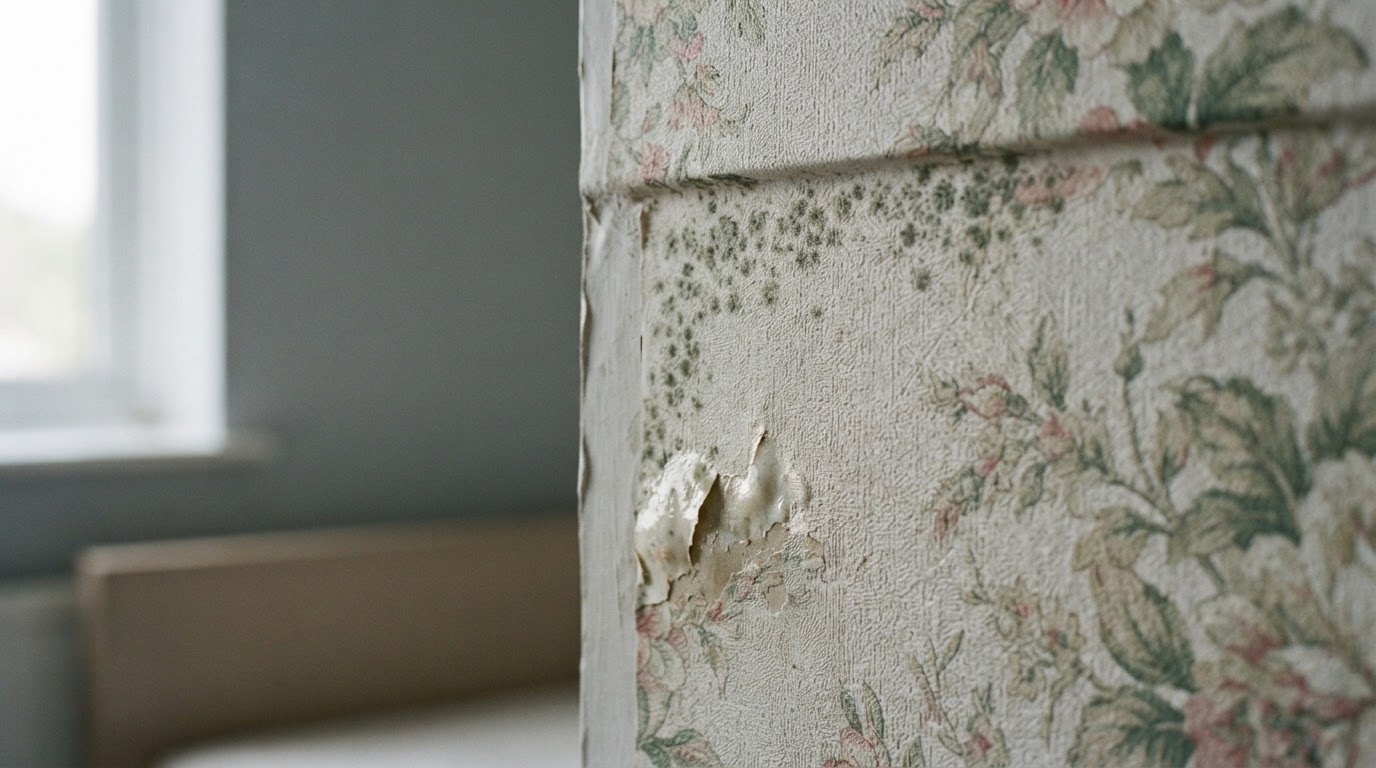
You scrub mould off the wallpaper, wait a week, and it’s back. You scrub it again with bleach — the black spots vanish. Two weeks later, there it is. Same spots. Same size. You’re left wondering what you’re doing wrong.
The honest answer is: you’re not doing anything wrong. You’re fighting a battle against a problem that lives inside the paper, not on its surface. Most people never realise this until they’ve spent months and money on cleaning products that don’t work.
Here’s what’s actually going on — and what you can genuinely save.
Why Mould Comes Back on Wallpaper
Mould needs three things: moisture, warmth, and a food source. In most UK homes during the condensation season, moisture is the main driver. But when mould keeps returning to the same wallpaper spot, the food source is doing a lot of the work.
Wallpaper is made of cellulose from wood pulp. That’s organic matter. Mould is a fungus; it doesn’t just sit on top, it feeds on the paper. Its root-like structures, the hyphae, grow down into the fibres and anchor themselves. Surface cleaning removes the visible stain, but it can’t reach spores embedded millimetres deep.
This is why bleach seems to work for a short while. It bleaches the pigment out of the mould, making it invisible. But the spores remain, intact and viable, still buried in the paper. Within weeks — sometimes days — the mould regrows from within.
Most paste adhesives also contain starches and proteins that mould finds nutritious. Even if you could sterilise the surface, the backing paste provides an ongoing food supply.
Practically speaking: if you have mould on wallpaper and you’re reaching for bleach or a mould spray, you’re treating the symptom. The cause — the food source and the embedded spores — remains.
The Hard Truth About Wallpaper
Mould on wallpaper is almost never salvageable. There is no cleaning product, specialist spray, or clever paint that fixes this properly. The only remedy is to strip the wallpaper, treat the wall surface, and repaint with mould-resistant paint.
Guidance from bodies like the Institute of Specialist Surveyors and Engineers (ISSE) is direct: wallpaper must be removed in mould-affected areas. This isn’t written to be cautious; it’s written because professionals have tried the alternatives and watched them fail. A contractor who says they can treat mould on wallpaper in situ has either misunderstood the biology or is prioritising a quick sale over a lasting result.
The pattern is consistent. Someone is told they can paint over it, treat it, or seal it. They do. It comes back — sometimes within a month. Then they’re paying for the stripping anyway, plus the cost of removing failed coating layers from the wall.
The one situation where you might delay stripping is if the mould is genuinely light surface contamination and you’ve fixed the underlying moisture source at the same time. Even then, stripping is the right answer, not a temporary coating. Mould-resistant paint is a preventative measure, not a cure for existing contamination.
If you’re a tenant in this situation, this is the point to contact your landlord in writing. A landlord’s legal duty under the Housing Health and Safety Rating System (HHSRS) includes addressing damp and mould hazards — and since Awaab’s Law, that duty has real teeth. You don’t need to accept a contractor who says they can paint over it. Shelter and your local council’s environmental health team can advise on your specific situation.
Can You Save Your Curtains and Fabric?
Fabric is a different story — but only if you approach it correctly.
Curtains, clothing, cushion covers, and soft furnishings can be salvaged after mould contamination, provided the fabric can withstand high-temperature washing. The thermal kill threshold for mould spores is around 60°C. Wash at that temperature or above with a laundry detergent, and you destroy the spores. Cold washing, lukewarm washing, and dry cleaning will not kill them.
This is genuinely good news. Curtains are expensive to replace, and if the mould contamination is light to moderate, a hot wash is usually enough. Owners who’ve been through this report that the smell vanishes along with the staining.
There are practical limits. If the care label says “dry clean only,” you have a problem: dry cleaning solvents don’t reliably kill mould spores. You’d need a specialist cleaning service with biocidal treatment capability, and at that point, the cost starts to approach replacement.
For heavier items like sofa covers, throws, or duvet covers: check the label, check your washing machine’s capacity, and consider drying in direct sunlight afterwards. UV light provides an additional spore-killing effect and helps eliminate residual musty odours.
Here’s the practical checklist for fabric salvage:
- Can it be washed at 60°C or above? (Check the care label)
- If yes: wash at 60°C, use a mould-safe detergent, dry in sunlight if possible
- If no (dry clean only or label forbids heat): either specialist biocidal cleaning or replacement
The honest reality is that most curtains, cotton throws, and machine-washable fabrics are salvageable. It’s the non-washable items — leather, silk, certain wallpaper-adjacent fabrics — that typically aren’t.
What About “Mould-Resistant” Paint?
Mould-resistant paint gets mentioned a lot, usually by someone trying to avoid stripping wallpaper. Let’s be clear about what it does and doesn’t do.
Mould-resistant paint — the kind professionals use, like certain Dulux Trade or Fungi-Shield products — contains biocides that inhibit mould growth on the surface of the paint film. It is genuinely more resistant than standard emulsion, but it is a barrier, not a cure. It only works if the mould source is gone.
If you paint mould-resistant paint directly over wallpaper that has active mould contamination — even if you’ve scrubbed the surface first — the mould will grow through the paint within weeks. The paper is still there, still organic, still moist, and the mould will find its way through.
What mould-resistant paint is good for: repainting a stripped, cleaned, and dried wall where the moisture problem has been resolved. It’s a sensible preventative measure in bathrooms, kitchens, and north-facing rooms that see a lot of condensation. It’s money well spent in the right context.
What it isn’t: a reason to skip stripping the wallpaper. It isn’t a licence to paint over an active problem.
How to Stop Mould from Returning
This is the part that matters most. Even if you strip the wallpaper and clean the curtains, the mould will come back if the moisture source is still there.
Identifying and fixing the moisture source is the non-negotiable first step. In most UK homes, that’s condensation — driven by the relationship between heating, ventilation, and everyday moisture production (showering, cooking, drying clothes indoors). In some cases, it’s a leak or penetrating damp from outside, which is worth ruling out before you spend money on ventilation improvements that won’t help.
Practical steps that actually work:
Keep humidity below 60%. A hygrometer costs from around £15 and tells you what you’re dealing with. In a bedroom or living room that regularly sits above 60% relative humidity in winter, a dehumidifier is worth its salt — owners consistently find a noticeable reduction in surface condensation and associated mould once they keep humidity in check.
Ventilate when cooking and showering. That extractor fan in the kitchen or bathroom only works if it’s actually running and venting to the outside air, not into the loft or a dead-ended duct. If you don’t have an extractor fan, open a window for 15 minutes after cooking or showering.
Heat the home adequately. Cold walls get condensation. It sounds obvious, but it’s the thing that gets missed when energy bills are tight. Even a modest background heat makes a significant difference to surface temperature on external walls.
Check your trickle vents. Double glazing sealed the draughts that used to ventilate older houses — which made them warmer but also more humid. Trickle vents exist to restore controlled ventilation. If they’re blocked or painted over, the humidity has nowhere to go.
If you’re dealing with this as a tenant, report the problem to your landlord in writing. Keep a copy. If they fail to act, Shelter, Citizens Advice, and your local council’s environmental health team are the right routes — not additional cleaning products.
Now you know what to look for — Get the Free Damp & Mould Diagnosis Checklist to help you pinpoint the exact cause in your home and work out what needs to change.
Mould Remediation: Salvageability Guide
| Item | Salvageable? | Method | Notes |
|---|---|---|---|
| Wallpaper | No | Strip & Repaint | Mould feeds on cellulose; surface cleaning fails. |
| Curtains (Washable) | Yes | 60°C Wash | Thermal kill threshold for spores. |
| Curtains (Dry Clean Only) | No | Specialist Cleaning | Solvents don’t reliably kill spores. |
| Sofa Covers | Conditional | 60°C Wash | Check machine capacity and care label. |
| Soft Furnishings | Conditional | 60°C Wash | UV drying in sunlight helps eliminate odours. |
| Mould-Resistant Paint | Preventative | Apply to Dry Wall | Not a cure for existing contamination. |
Frequently Asked Questions
Can you paint over mould on wallpaper?
No. Painting over mould — even with mould-resistant paint — is a temporary fix that will fail. The mould is growing inside the paper fibres, and it will grow through any coating applied over it. You must strip the wallpaper, treat and dry the wall, and repaint.
Does washing curtains at 40°C kill mould?
No. You need to wash at 60°C or higher to kill mould spores. Cold washing, 30°C, and 40°C cycles will not destroy the spores — they’ll survive and potentially spread to other items in the wash. If the fabric can’t be washed at 60°C, dry cleaning alone won’t solve the problem either; you need specialist biocidal cleaning or replacement.
Is it safe to sleep in a room with mould on the wallpaper?
For most healthy adults, occasional exposure to low-level mould is not harmful. According to NHS guidance, mould can irritate eyes, skin, and airways, and it can worsen asthma. If someone in your household has a respiratory condition, is very young, or is older or immunocompromised, you should address the mould as a priority — not least because the underlying moisture problem may also be affecting the fabric of the building. If you have health concerns, speak to a GP.
What is the best way to remove mould from wallpaper?
There isn’t one. Wallpaper cannot be reliably decontaminated once mould has penetrated the paper. The correct approach is to strip the wallpaper, treat the exposed wall with a mould treatment solution, allow it to dry fully, and then repaint with mould-resistant paint.
How do I know if my mould is condensation or rising damp?
Condensation typically appears on cold surfaces — windows, mirrors, and external walls — and is usually worse in winter when the temperature drops. Rising damp appears as a tide mark at the bottom of a wall, typically above the skirting board, and persists regardless of weather. If you’re not sure, our free diagnosis checklist walks you through the distinguishing signs.
Here’s the honest summary. If you have mould on wallpaper, budget for stripping and repainting — it’s not the answer you wanted, but it is the answer that works. Your curtains are almost certainly salvageable with a hot wash. And whatever you do, don’t spend money on cleaning products or coatings that claim to fix wallpaper in situ. They won’t. Fix the moisture, and the mould stops coming back.
Grab our free damp and mould diagnosis checklist to work out exactly what kind of damp you’re dealing with — because the right fix depends entirely on getting the diagnosis right first.
Related Guides
For a complete overview, see our How to Remove Black Mould From Walls Safely .
Sources & Further Reading
Note: General guidance only. Always verify specific remediation steps with a qualified professional or official source.