Why Your House Has Condensation and How to Fix It

eBay Partner Network: I earn a commission when you buy through eBay links on this page.
As an Amazon Associate we earn from qualifying purchases. Some links on this page are affiliate links, which means we may earn a small commission if you make a purchase.
You wake up on a November morning, pad over to the window, and there it is — a film of water running down the glass. You wipe it away. It comes back by teatime. A few weeks later, there’s a dark patch in the corner of the bedroom wall that wasn’t there before. The instinct is to panic, call someone out, and brace for a bill for damp proofing you don’t fully understand.
The honest answer is that there’s a very good chance this isn’t rising damp. It’s not a structural problem. It’s condensation — and it has a completely different fix.
The frustrating part is that most people get sold a solution to the wrong problem. This article explains exactly what’s happening in your home, why it started or got worse in the last decade, and what actually works to fix it. No scare tactics. No unnecessary quotes.
Is It Condensation, Rising Damp, or a Leak?
Before anything else, you need to know what you’re dealing with. Damp falls into three broad categories, and the fix is completely different for each. Getting this wrong means spending money on the wrong solution — which is exactly what firms with free surveys want.
Condensation is the most common cause of damp in UK homes. It forms when warm, moist air meets a cold surface — a window, a north-facing wall, the inside of an external door. The air can’t hold the moisture anymore, so it drops it as water droplets. You’ll notice it on glass first, then on walls that don’t get much warmth or airflow. Mould follows, typically in corners and behind furniture where the air sits still.
Rising damp is less common than people think — it’s quite rare in modern UK homes. It happens when groundwater soaks up through the brickwork below the damp proof course (DPC), usually because the DPC has failed or was never installed properly. The telltale sign is a tide mark on walls, typically up to about one metre high, with skirting boards or plaster directly above affected. If you see this pattern, it’s worth getting a proper survey — but rising damp caused by a failed DPC is a specific structural issue, not the same as a moisture problem you can ventilate away.
A leak shows up differently. Water from a burst pipe, a faulty roof, or a penetrating defect tends to appear as a damp patch that’s patchy and uneven, often on a ceiling or high on a wall, and it doesn’t follow the seasonal pattern of condensation. If you’ve got a patch that appeared suddenly or after heavy rain, or one that doesn’t go hand-in-hand with window condensation and bathroom steam, a leak is more likely than condensation.
One practical tip worth knowing: if you’re unsure whether a damp patch is from a hidden leak, check whether it’s on an external wall or an internal one. Condensation almost always appears on external surfaces because those are the cold surfaces — walls that back onto unheated garages, or windows in north-facing rooms. A damp patch on an internal wall, away from any bathroom or kitchen, is worth investigating more carefully.
| Condensation | Rising Damp | Leak | |
|---|---|---|---|
| Typical location | Windows, north walls, corners, behind furniture | Skirting boards, ground-floor walls up to ~1m | Ceilings, high walls, patches unrelated to rooms used |
| Pattern | Worse in winter, improves with ventilation | Persistent regardless of weather | Sudden onset or after rain |
| Tide mark | No | Yes, often visible | No |
| Linked to steam sources | Yes — cooking, showering, drying clothes | No | No |
If you’re still unsure after reading this, the honest move is to use our damp diagnosis checklist before spending anything on a contractor. Getting the diagnosis right saves far more than it costs.
The Real Reason Your Home Is Sweating
This is the bit that matters most, because it changes everything about how you think about the problem.
Here’s what’s happened to British homes over the past thirty years. Double glazing became standard. Draught-proofing got fitted around doors and windows. Cavity wall insulation went in. Loft insulation levels increased. All of this was done to save energy — and it does. But it also sealed the house in a way it never was before.
In an older pre-1980s home, air escaped constantly through gaps in single-glazed window frames, through unsealed floorboards, up through unused chimney flues, and around poorly insulated loft hatches. That sounds uncomfortable, and it was — but it also meant moisture had a route out. A typical UK household produces between 10 and 15 litres of moisture every single day: from breathing and perspiring, from cooking, from showering, and from drying clothes indoors on radiators or airers. In a draughty old house, a lot of that simply left through the gaps.
Modern homes don’t have those gaps. Double glazing, draught excluders, cavity wall insulation, and better loft insulation reduce air changes from roughly 1.5 per hour to around 0.3 per hour. That’s not an exaggeration — it’s what UK Building Regulations Approved Document F (Ventilation) is specifically written to address. Because the builders know that when you seal a house to that level, moisture has nowhere to go unless you put mechanical ventilation in.
The physics is straightforward. Warm air holds more moisture than cold air. When the warm, moist air from your living room drifts across to a north-facing window — which stays cold even when the room is heated — the air temperature drops. As it drops, it can no longer hold the moisture it was carrying. That moisture condenses out onto the glass. The same thing happens on cold external walls, which is why mould so often appears in corners, behind wardrobes, and on walls that don’t get much direct heat.
So the real reason your home is sweating is that it produces a lot of moisture and it no longer vents itself. The fix isn’t necessarily expensive damp proofing. It’s usually one or more of three things: reduce the moisture going in, improve the ventilation so what’s there can escape, or keep the cold surfaces warm enough that condensation can’t form on them.
The honest answer for most people is a combination of all three — but the order matters, and where you start depends on your situation. If you rent, your landlord has a legal duty to address structural causes and faulty ventilation. If you own, you’ve got more flexibility but also more responsibility to find the right fix.
The 3-Step Fix (That Actually Works)
Once you understand the mechanism, the fix falls into place naturally. The key thing to know is that none of these steps alone is usually enough — it’s the combination that works.
Step 1: Reduce Moisture at the Source
This is the most effective long-term strategy. If less moisture enters the air in the first place, your home has a much easier job staying dry.
The biggest moisture producers in most households are cooking and drying clothes. When you boil a pan without a lid, you’re adding a significant amount of water vapour to the air. Put the lid on. It’s a small change but it makes a measurable difference over a week of meals.
Drying clothes indoors on radiators is one of the most common causes of persistent condensation in UK homes. A load of laundry hung on a radiator in a closed room can release several litres of moisture into the air, which then has nowhere to go except onto the nearest cold surface. If you can, dry clothes outside — even in winter, outdoor drying is far more effective than most people realise. If you genuinely can’t, use a dehumidifier in the same room while the clothes are drying, and keep the door closed so the moisture doesn’t spread.
Showers produce a lot of moisture very quickly. Keep the bathroom door closed while showering and for at least 20 minutes afterwards, and run the extractor fan throughout.
Step 2: Improve Ventilation
This is where the real fix lives for most UK homes. Reducing moisture helps, but if your home is sealed, you need to actively move air through it.
Extractor fans in kitchens and bathrooms are the most effective single intervention for most homes. They actively pull moist air out and vent it outside — not into the loft, not into a duct that ends somewhere else, but outside. If your kitchen or bathroom doesn’t have one, or the one you have vents into the loft, it’s worth installing a proper one.
Opening windows slightly while cooking or showering makes a noticeable difference, even in winter. It sounds counterintuitive to deliberately let cold air in, but that cold air is dry compared to the warm, moisture-laden air inside — and it carries the moisture out. A window opened just a few inches for an hour after cooking or showering can prevent an enormous amount of condensation building up overnight.
Trickle vents — the narrow vents built into the top of many double-glazed window frames — exist precisely for this reason. If yours are closed, open them. If your windows don’t have them, it’s worth asking a glazier about fitting them. They allow a small, constant trickle of fresh air without creating a draught.
Step 3: Warm the Cold Surfaces
If you can keep the surfaces where condensation forms above the dew point, condensation won’t form on them. This is the simplest version of the physics: warm air can hold moisture; cold surfaces pull the moisture out of the air.
The practical implication is keeping your home heated to at least 18°C in the rooms you use regularly. This doesn’t mean blasting every room — it means not allowing cold spots to develop on external walls that are then hit by warm, moist air from the rest of the house. Leaving a bedroom completely unheated through winter, then closing the door and letting warm air from the landing condense against the cold walls, is one of the most common patterns that leads to mould in spare rooms and guest bedrooms.
What works best depends on your situation:
- If you rent and the damp is caused by a faulty extractor fan or poor ventilation, your landlord is legally responsible for fixing it. Ventilation improvements and moisture reduction are things you can do yourself, but the landlord must address the root cause.
- If you own a modern insulated home with persistent condensation, ventilation is likely the missing piece — mechanical ventilation, not just opening windows.
- If you have a specific cold spot — a north-facing wall, a corner behind a wardrobe — that’s showing mould, warming that area or improving airflow around it will help while you work on the broader moisture reduction.
Not sure if condensation is your actual problem? That’s exactly what the Free Damp & Mould Diagnosis Checklist is for — walk through it before you spend anything.
When You Need a Professional (And When You Don’t)
Here’s the honest line: for most condensation problems, you don’t need a professional. The fix is behavioural and costs very little — lids on pans, an extractor fan running, a dehumidifier in the right room. But there are situations where professional help is the right call, and getting the wrong help is genuinely costly.
When you don’t need a professional: If your damp shows up on windows and walls in rooms you use daily, if it gets worse when you cook or shower and better when you ventilate, and if it’s seasonal — worse in autumn and winter — then condensation is almost certainly the cause. The three-step fix above is where you start.
When you do need professional help: If the damp is patchy, appears on internal walls, doesn’t follow the seasonal pattern, or shows a visible tide mark on lower walls, there may be a structural issue — rising damp from a failed DPC, a leaking pipe, or penetrating damp from a defect in the roof or walls. In these situations, DIY fixes will fail. You need a proper damp survey from an independent surveyor, not a contractor who is also quoting to do the work — that conflict of interest is worth knowing about.
If you’re a tenant: Your landlord has a legal responsibility to fix damp and mould that is caused by structural problems, faulty installations, or conditions that make the property unhealthy to live in. This is what Awaab’s Law is designed to enforce in social housing — that damp and mould are treated as urgent hazards, not left to fester while liability is argued over. If you’re renting privately and your landlord won’t act, you should report the problem in writing (keep the emails), take dated photographs, and contact your local council’s environmental health team. Shelter and Citizens Advice can advise on your specific situation.
One thing worth saying plainly: don’t accept a free survey from a firm that’s also selling you damp proofing work. That survey will always find damp proofing is needed. Use an independent surveyor — look for PCA (Property Care Association) membership, which is a professional body that includes damp and timber specialists. A second opinion from an independent source costs a few hundred pounds and is money well spent before committing to thousands.
Tools That Help (But Don’t Replace the Fix)
There are three categories of product that come up repeatedly when people are dealing with condensation. They’re genuinely useful — but only if you understand what they can and can’t do. None of them replaces the fundamental fix of managing moisture and ventilation.
Hygrometers
A hygrometer measures the relative humidity in a room. Knowing the humidity level takes a lot of the guesswork out of knowing whether you’re winning or losing the moisture battle. For most people, a simple digital hygrometer is enough — you don’t need anything fancy.
The ThermoPro TP50 (paid link) is consistently praised by UK buyers for accuracy and ease of use. It has a clear display, a magnetic back and stand, and it runs reliably for years — owners report them going the distance without complaint. The catch is the display: there’s no backlight, which means it’s hard to read in a dark room, and it doesn’t connect to your phone or send alerts. It’s a measurement tool, not a monitoring system. If you want to check humidity in your bedroom, nursery, or living room with a quick glance, it does the job well. If you need smart features or data logging, look elsewhere.
See current price on Amazon → (paid link)
For a budget alternative with a bit more tech, the Brifit Digital Hygrometer (paid link) (sold as a 2-pack) offers Bluetooth connectivity and an app so you can check readings remotely. UK buyers appreciate the accuracy and the history data export. The problem is the battery: non-standard batteries that need replacing more often than you’d like, and some owners report the batteries dying within a couple of months. It’s handy if you want remote monitoring, but factor in the battery inconvenience before you commit.
If you just want a number and don’t care about branding, a generic digital hygrometer (eBay paid link) costs a few pounds on eBay and does the basic job — no app, no history, just a humidity reading.
Dehumidifiers
A dehumidifier removes moisture from the air — it’s genuinely useful when you’ve got a persistent damp problem or you’re drying clothes indoors. But it’s a complement to ventilation, not a replacement for it. If your home has no extractor fan and windows that stay closed, a dehumidifier will keep running without solving the underlying problem.
For a bedroom or small flat with condensation problems, the Meaco Arete One 12L (paid link) is a strong pick. Owners consistently rate it for quiet operation and effective moisture removal — it’s not going to disturb your sleep, and it genuinely pulls water out of the air in a damp room. The tank is easy to empty and the unit is compact. The honest caveat is the price: it’s not cheap, but owners who have dealt with cheaper models say the extra spend is worth it for the quietness and reliability. The laundry mode works, though some owners find it could run a bit longer.
If you’re on a tighter budget, the EcoAir DC12 is the honest pick. It removes moisture effectively, it’s compact, and it’s priced accessibly. The trade-off is noise — it’s not quiet enough for overnight bedroom use for most people, and the water tank design is a bit awkward to empty. But for a spare room or a kitchen used during the day, it does a solid job.
For a larger home or a room with serious damp, the Meaco Arete One 20L (paid link) handles more moisture more quickly. It’s heavier and less portable than the 12-litre model, and it can be noisier on the laundry setting, but owners who need serious moisture removal in a larger space rate it highly. The EcoAir ECO20LDG (paid link) is the more affordable alternative — it pulls moisture fast and reduces window condensation, but the droning noise and frequent tank emptying are the consistent gripes.
Mould Removers
Cleaning surface mould is satisfying and worth doing, but it doesn’t fix the underlying damp. If you clean the mould and don’t address why it’s growing, it’ll be back within a season. Think of mould removers as part of the clean-up phase after you’ve sorted the moisture problem, not the fix itself.
The HG Mould Remover (paid link) is fast and effective — owners say it clears black mould from bathroom tiles, grout, and silicone seals in 10 to 30 minutes with little or no scrubbing. The catch is the smell: it has a very strong chlorine bleach odour, and you genuinely need good ventilation when using it. It’s the honest pick for people who want a visible result quickly, but only if you’re also addressing why the mould appeared in the first place.
The Astonish Mould & Mildew (paid link) spray is the budget option and holds its own. UK buyers describe it as fast, effective on light to moderate bathroom mould, and good value for money. It has the same strong bleach smell as most mould removers, and some owners note occasional packaging issues. For regular maintenance cleaning in a bathroom, it’s a perfectly reasonable choice — just don’t expect it to solve a persistent damp problem on its own.
Frequently Asked Questions
Is black mould toxic?
No — not in the way the word “toxic” is usually understood. The mould most commonly found in UK homes (Cladosporium) is an allergen and can irritate the eyes, skin, and throat, particularly for people with asthma or respiratory conditions. The NHS and gov.uk guidance does link damp and mould to respiratory problems, especially in children, older people, and those with weakened immune systems, and that is worth taking seriously. But the idea that common black mould in homes is “toxic” in the dramatic sense is a marketing invention by firms that want to sell you a cure. Clean it up, fix the damp, and if anyone in your household has health concerns, speak to a GP.
Can I paint over mould?
No — not if you want it to stay gone. Paint over mould and you’re trapping moisture inside the wall, which makes the problem worse and can damage the paint or wallpaper. The mould grows back, often faster. You need to clean the surface with a proper mould treatment first, let the wall dry out fully, then paint with a mould-resistant paint if the underlying moisture problem has been resolved. Painting over mould is the definition of papering over the cracks.
How often should I run my extractor fan?
Run it for at least 20 minutes after cooking or showering, and ideally leave it on for the duration of the activity. Some fans are set up to run continuously on a low setting, which is fine — what you’re aiming for is that the bathroom or kitchen air is being actively replaced rather than sitting full of steam that then drifts into the rest of the house. If you don’t have an extractor fan in your bathroom, and you’re renting, this is your landlord’s responsibility to install. If you own and there’s no fan, it’s one of the most worthwhile upgrades you can make for the cost.
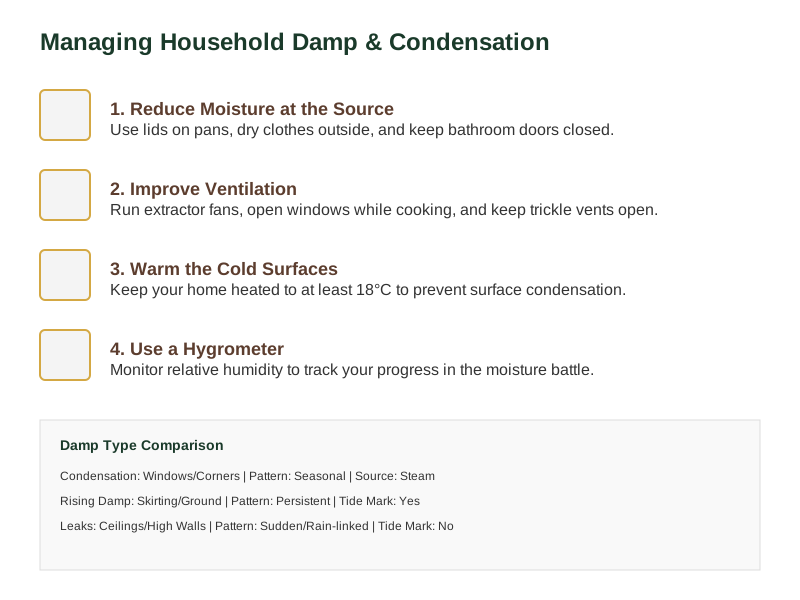
Damp Types: How to Identify the Cause
| Feature | Condensation | Rising Damp | Leak |
|---|---|---|---|
| Typical Location | Windows, north walls, corners | Skirting boards, ground-floor walls up to ~1m | Ceilings, high walls, patches unrelated to rooms used |
| Pattern | Worse in winter, improves with ventilation | Persistent regardless of weather | Sudden onset or after rain |
| Tide Mark | No | Yes, often visible | No |
| Linked to Steam Sources | Yes — cooking, showering, drying clothes | No | No |
Where to Go From Here
The core message is a simple one: condensation is almost always a moisture and ventilation problem, not a structural one. And it’s fixable without spending thousands on damp proofing you don’t need. The three-step approach — reduce moisture at the source, improve ventilation, keep cold surfaces warm — works for the vast majority of homes where the problem is condensation.
What changes the picture is your situation. If you rent and the damp is caused by faulty ventilation or a structural problem, you need your landlord to act — and if they won’t, you have routes through the council and environmental health. If you own a modern, well-insulated home and you’re still getting condensation, it’s almost certainly because the ventilation hasn’t kept pace with how airtight the property has become. That’s fixable, but it requires the right approach.
If you’re not sure whether condensation is your actual problem, or whether something more serious is going on, start with our Free Damp & Mould Diagnosis Checklist . It’s a short set of questions that helps you narrow down what’s actually happening before you spend money on a solution.
And if you’ve been told you need damp proofing but you’re not certain why — get a second opinion from an independent surveyor before you commit to anything. The cost of that second opinion is negligible compared to the cost of unnecessary work.
Explore More Topics
Go deeper on specific topics:
- Why Double Glazing Made Condensation Worse in UK Homes
- Trickle Vents: Do They Actually Stop Condensation?
- Extractor Fans: Why Most UK Bathroom Fans Don’t Work Properly
- Drying Laundry Indoors Without Wrecking Your Walls
- Condensation on Bedroom Windows Every Morning: Why and the Fix
- Positive Input Ventilation: Is a PIV Unit Worth the Cost?
Sources & Further Reading
As an Amazon Associate we earn from qualifying purchases.
Note: General guidance only, verify details with a qualified professional or official source.
Buy Astonish Mould & Mildew on Amazon → (paid link)
Buy HG Mould Remover on Amazon → (paid link)
View EcoAir ECO20LDG on Amazon → (paid link)
See Meaco Arete One 20L on Amazon → (paid link)
See Meaco Arete One 12L on Amazon → (paid link)
View Brifit Digital Hygrometer on Amazon → (paid link)