Do Trickle Vents Stop Condensation? (The Honest Answer)

As an Amazon Associate we earn from qualifying purchases. This page contains affiliate links — if you buy through them, we earn a small commission at no extra cost to you.
You’ve had new windows fitted. The salesman pointed to the small slots at the top — trickle vents — and promised they’d stop the condensation. Six months later, there’s black mould creeping up the bedroom wall, and you’re wondering what went wrong.
The honest answer is that trickle vents aren’t the problem, but they aren’t the solution either — not on their own. The real issue is that most UK homes generate more moisture than any window slot can shift, and a truly effective ventilation strategy requires more than just leaving a vent open. This article explains why the logic behind trickle vents is sound, why the practice often falls short, and what actually fixes the problem.
What Trickle Vents Actually Are
Trickle vents are small background ventilators integrated into the top or sides of a window frame. They have two staggered slots — one on the outside, one on the inside — which prevent a direct draught while allowing a slow, constant exchange of air. The idea is that you leave them open all the time, so the home gets a steady trickle of fresh air rather than relying on someone remembering to open a window.
Think of them as a slow, steady drip rather than a sudden burst. They are designed into modern double-glazed windows specifically to provide background ventilation in homes that have been made much more airtight. Without some form of background air supply, modern sealed windows trap moisture that would previously have escaped through gaps around the frames.
The Problem with “Just Vents”
The mechanism behind condensation is straightforward: warm air holds more moisture than cold air, and when that moisture-laden air meets a cold surface — a window pane or an external wall — the moisture condenses into water droplets. The more moisture you generate indoors, and the colder those surfaces, the worse the problem gets.
The airflow through a trickle vent is designed to dilute that moisture gradually. But “gradually” is the operative word. A single ten-minute shower releases roughly 1.5 litres of moisture into the air. A trickle vent removes that moisture at a rate measured in hours, not minutes. Add in cooking, clothes drying indoors, and normal breathing, and you can see how the gap between moisture production and removal widens quickly.
There is also a behavioural problem that the window industry rarely mentions. Most homeowners close their trickle vents. The draught — even the reduced, staggered one — feels cold, and in a world of rising energy bills, leaving a slot open in February feels like throwing money away. The moment a trickle vent is closed, it stops providing any ventilation at all. The moisture stays in the house, and the condensation returns.
This isn’t a failure of the homeowner. It’s a failure of the design brief: a passive system that requires occupants to tolerate discomfort in order to function was always going to struggle in practice.
The Verdict: What Actually Works
Trickle vents are necessary in modern, airtight homes — but they are not sufficient on their own. The UK Building Regulations Approved Document F, updated in 2021, reflected this reality by raising minimum ventilation rates and explicitly requiring mechanical extract ventilation in wet rooms like bathrooms and kitchens. The regulation acknowledges that background ventilation through window vents cannot handle the moisture loads generated by a typical modern household.
The effective strategy is a three-layer approach:
- Trickle vents stay open all the time for background air exchange — the constant, low-level dilution that prevents moisture from building up between bigger events.
- Extractor fans run in wet rooms when moisture is being generated — showering, cooking — and for a period afterwards. These remove moisture at a rate that trickle vents simply cannot match.
- Window opening handles the periodic deep-ventilation that every home needs: ten to fifteen minutes of wide opening when weather allows, particularly after cooking or showering, or first thing in the morning.
For most UK homes, that combination solves the problem. If you have a bathroom with no extractor fan, trickle vents alone will not stop the mould from shower steam — no matter how well you maintain them. If you have extractor fans but keep your trickle vents closed, you’re relying entirely on those fans and opening windows, managing moisture reactively rather than preventing it from building up in the first place.
The right combination depends on your home and your routine. But the starting point — keeping trickle vents open — costs nothing and requires no installation. It is the baseline that everything else builds on.
Now you know what to look for — Get the Free Damp & Mould Diagnosis Checklist to confirm whether your issue is condensation or something that needs a different approach.
How to Use Vents Effectively (If You Must)
If extractor fans aren’t an option and you cannot open windows regularly, then trickle vents become more important, not less. The advice to leave them open applies all year round, including winter. Cold outside air actually holds less moisture than warm inside air, so exchanging it reduces relative humidity even when it feels counterintuitive to let cold air in.
The common mistake is treating trickle vents like a window: open when you remember, closed when it’s cold. That inconsistency defeats the purpose. They are designed for continuous operation, and their benefit is that they require no effort to maintain background ventilation once you commit to leaving them alone.
The do’s and don’ts in practice:
- Do leave trickle vents open all the time, even when you’re not in the room.
- Do use extractor fans in bathrooms and kitchens — they handle the peaks that trickle vents cannot.
- Do open windows fully for ten to fifteen minutes a day when the weather allows.
- Don’t close trickle vents to save heat — you’re trapping moisture in the process.
- Don’t rely on trickle vents as your only ventilation strategy if you have a bathroom with no extractor fan.
If mould has already appeared, treat it with a proper fungicidal wash — HG Mould Remover (paid link) and Dettol Mould & Mildew Remover (paid link) are widely available and do the job on hard surfaces. Bleach masks the problem rather than treating it: it kills surface mould on non-porous tiles but does not reach into porous plaster, and the mould will return.
See it on Amazon → (paid link)
Frequently Asked Questions
Are trickle vents mandatory in new UK homes?
Yes, under Building Regulations Part F, background ventilators are required on most replacement and new windows in England. The 2021 update made the requirements more stringent, particularly where a property has a history of condensation or mould. If you are replacing windows, the new unit generally must have vents of at least the same size as the original — and often larger under the current standards.
Can I remove trickle vents from my windows?
If you are replacing windows, you generally cannot remove them. Building Regulations require the replacement window to provide equivalent or improved background ventilation. Removing them entirely would be non-compliant, and any installer who fitted windows without them would be in breach of regulations.
Do trickle vents cause damp?
No — they are designed to prevent damp by providing airflow. Closing them can actually cause damp, because it stops the background ventilation that dilutes moisture in the room. If you have damp despite having trickle vents, the most likely explanation is that they are closed, or that the overall ventilation strategy is insufficient for the moisture load in the property.
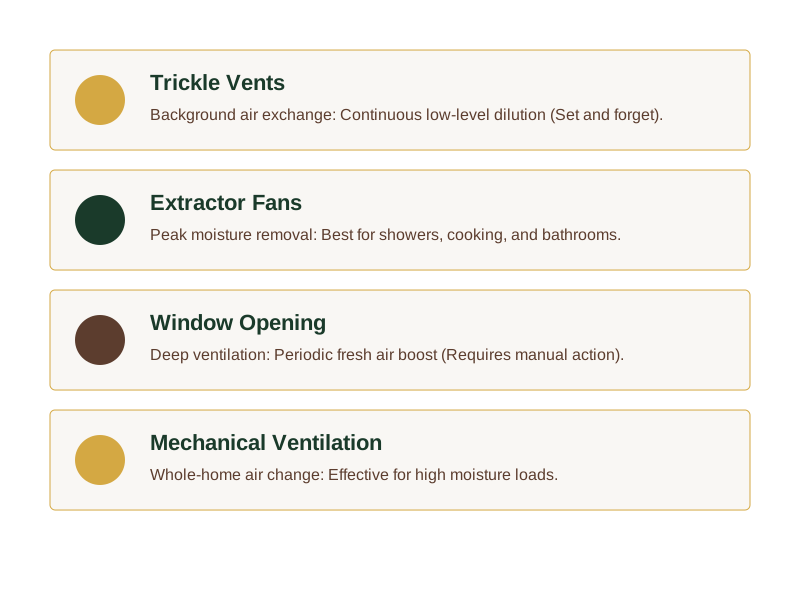
Ventilation Strategy Comparison
| Ventilation Method | Primary Function | Best For | Maintenance Required |
|---|---|---|---|
| Trickle Vents | Background air exchange | Continuous low-level dilution | None (set and forget) |
| Extractor Fans | Peak moisture removal | Showers, cooking, bathrooms | Switching on/off as needed |
| Window Opening | Deep ventilation | Periodic fresh air boost | Remembering to do it |
| Mechanical Ventilation | Whole-home air change | High moisture loads | Installation and running costs |
Taking the Next Step
Trickle vents are a necessary part of a modern ventilation strategy, but they are one tool in a toolkit rather than the complete answer. The homes that manage condensation and mould best tend to have extractor fans in wet rooms, a habit of opening windows for short periods, and trickle vents that are simply left to do their background job without interference.
If you’re still seeing mould despite having trickle vents open, the question worth asking is whether the rest of the ventilation picture is in place — and whether what you’re dealing with is actually condensation, rather than rising damp or a penetrating leak. Those are different problems with different solutions, and getting the diagnosis right first means not spending money on the wrong fix.
For a structured way to work out what you’re actually dealing with, the free checklist walks through the key indicators — where the damp appears, what the patterns look like, and when to call in a professional rather than reaching for a tin of anti-mould paint.
Get the Free Damp & Mould Diagnosis Checklist .
Related Guides
For a complete overview, see our Why Your House Has Condensation and How to Fix It .
Sources & Further Reading
As an Amazon Associate we earn from qualifying purchases.
Note: General guidance only, verify details with a qualified professional or official source.
View Dettol Mould & Mildew Remover on Amazon → (paid link)