Why Your New Bathroom Fan Isn't Stopping Mould
As an Amazon Associate we earn from qualifying purchases. Some links on this page are affiliate links, which means we may earn a small commission if you make a purchase.
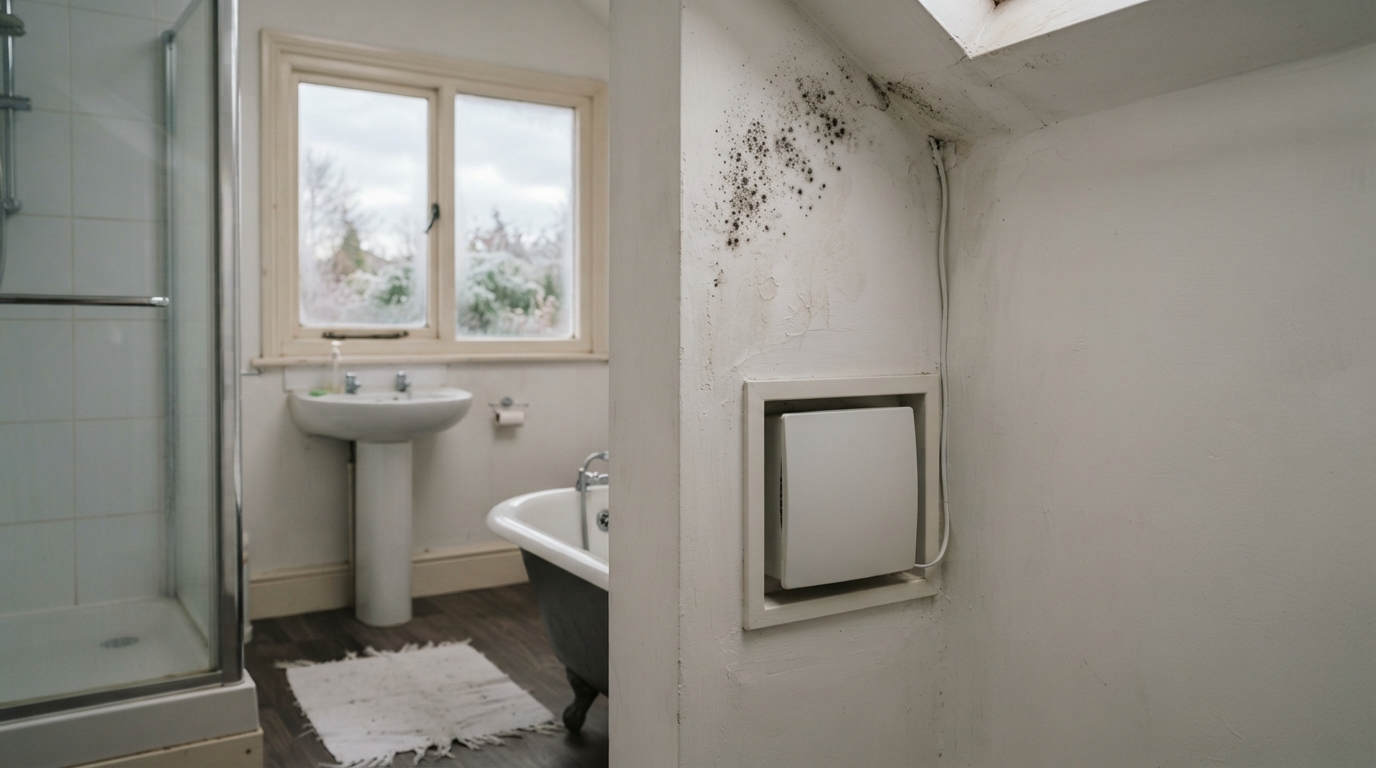
You finish a shower, wipe the mirror, and switch off the fan. Five minutes later the window is steamed up again, and you can already see black patches creeping back along the ceiling. You bought a new fan—a decent one, not the cheapest option—so why is the mould still winning?
That frustration is one of the most common things we hear from UK homeowners and tenants. The bathroom is doing exactly what a bathroom should: producing huge amounts of steam every time someone showers. The fan is switched on. The mould comes back anyway. The assumption is that the fan is underpowered, or that something more serious is going on—rising damp, perhaps, which would mean expensive structural work.
More often than not, the real problem isn’t the fan at all. It’s where the fan is venting to.
The Real Cause of Your Bathroom Condensation
Before getting into the ducting, it’s worth understanding why bathrooms are the worst room in the house for condensation.
A single shower releases several litres of water vapour into the air—far more than cooking or even breathing contributes. Add in the moisture from a bath, from drying towels, and from the general humidity an occupied household generates, and you’re looking at a bathroom that puts far more moisture into the air than most people realise.
The UK makes this worse in winter. Cold external walls, windows, and ceilings all sit well below the dew point of warm, moist bathroom air. When that air hits a cold surface, moisture condenses into droplets. On a tiled wall that’s fine; on a painted ceiling, that moisture sits until it evaporates or is absorbed. Mould doesn’t need much encouragement at that point.
What many people don’t realise is that modern insulation makes this worse. You seal the draughts, fit double glazing, and insulate the loft—all good for heating bills, but it also means the house holds onto moisture far more effectively. There’s less uncontrolled ventilation to dry things out.
The honest answer is that without a way to remove that moist air, it has to go somewhere. Either it stays in the room and condenses on the coldest surface, or it gets extracted. That is the job an extractor fan is supposed to do. But here’s where most UK fans fall short.
The “Loft Vent” Mistake
This is the bit that catches almost everyone out, and it’s the reason a new fan so often makes no difference.
Most UK bathroom extractor fans—particularly those installed in houses built or renovated before around 2005—don’t vent to the outside at all. They vent into the loft.
That means the ducting runs from the fan unit, usually through the ceiling, and terminates in the loft space. The moist air goes up, into the roof void, and stops there. It doesn’t go outside.
Here’s why that matters. The loft is cold in winter. When warm, moist air from the bathroom hits the cold underside of the roof membrane, it condenses. That moisture then drips down onto the insulation and timbers, eventually finding its way back into the house—often through gaps around light fittings, the loft hatch, or simply by migrating through the ceiling plaster. The loft becomes a moisture reservoir sitting directly above your bedrooms.
A fan venting into the loft is worse than no fan at all. Without a fan, the moisture at least stays in the bathroom and has a chance to dissipate when someone opens a window. With a loft-venting fan, you’re actively pumping moisture into a space designed to be cold—and it goes nowhere useful.
This is also a building regulation issue. Approved Document F of the UK Building Regulations is clear: extract fans in bathrooms and kitchens must discharge to “the outside air”—not into roof spaces, wall cavities, or ducts that terminate indoors. Venting into a loft is a technical breach of the regulations that have been in place since at least 1995.
The fix is straightforward in principle: the ducting needs to run through the roof or through an external wall to the outside. That might mean a new duct run, possibly cutting through the soffit or the roof tiles. It’s a bit of a faff, but it’s the only thing that actually solves the problem.
How to Check Your Fan’s Ducting
You don’t need specialist tools for this, though a torch is useful.
First, locate the fan unit—usually on the ceiling or high on a wall. Look at the ducting coming out of the back of it. Most bathroom fans use white flexible ducting, roughly 100mm in diameter.
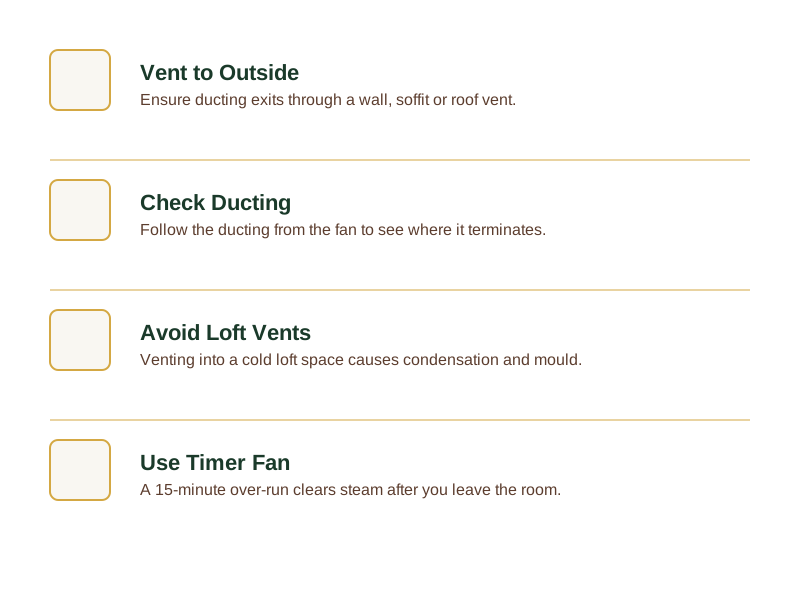
Follow that ducting. If it disappears into the ceiling and doesn’t clearly terminate through the roof or an external wall, the chances are it’s venting into the loft. If the ducting exits through a soffit vent on the side of the house, or through a tile vent on the roof, that’s the right setup.
Common signs that it’s venting into the loft:
- The ducting terminates in the loft space with no exit through the roof or wall
- There’s a short length of ducting simply dangling in the loft
- You can see condensation or damp patches in the loft near the duct termination
- The ducting vents into a general loft vent rather than a dedicated duct
If this is what you’ve found, the fan itself isn’t the problem—the ducting is. A more powerful fan would just pump moisture into the loft faster. You need to fix the ducting first.
For anyone looking at installing a new fan or fixing an existing installation, the how-to-install process is worth understanding before committing to a purchase. Get the Free Damp & Mould Diagnosis Checklist to make sure you’re solving the right problem—ventilation issues can look similar to rising damp on the surface, but the fix is completely different.
What If You Don’t Have an Outside Wall?
Some bathrooms—particularly those created from internal rooms in conversions or extensions—have no window and no outside wall for a duct to exit through.
In this situation, an extractor fan isn’t optional: it’s required by building regulations. A room with no openable window must have mechanical extract ventilation. The fan must still vent to the outside, not into a void or a neighbouring room.
For these internal bathrooms, the fan should have a timer function—typically a 15-minute over-run that keeps the fan running after the lights are switched off. This clears the remaining steam without requiring the occupant to remember to leave the fan on. It’s a requirement under Approved Document F for exactly this reason.
Continuous extract is another option for larger bathrooms—a low-speed fan that runs all the time rather than cycling on and off. This suits rooms that generate a lot of moisture regularly, though it does add to running costs.
If you’re in a rented property and your bathroom has no outside wall and no working fan, this is worth reporting to your landlord in writing. It’s a building regulation requirement, not a preference.
Choosing the Right Fan (If You’re Replacing It)
If you’ve checked the ducting and it’s correct—or you’re installing a new system from scratch—the fan itself does matter, but probably not in the way most people assume.
The key spec is airflow rate. For a standard bathroom, building regulations require an intermittent extract fan capable of at least 15 litres per second. For a continuous extract system, the minimum is lower—around 8 litres per second—but it runs all the time. Most decent 100mm axial fans will meet the 15 l/s figure, but it’s worth checking the spec before buying.
What buyers actually report matters more in practice is noise. The cheapest fans can be surprisingly loud—the kind of noise that makes using the bathroom at midnight feel antisocial. Buyers who have replaced a basic fan with a model marketed as quiet consistently notice the difference, particularly if the bathroom is next to a bedroom. The Vent-Axia 100T (paid link) comes up frequently in owner feedback as a model that strikes a reasonable balance—very quiet on low speed, though the high speed is still audible. The Manrose XF100T (paid link) is another commonly mentioned option, praised for ease of fitting and a useful timer function, though owners note it’s only moderately quiet rather than silent.
Check Amazon price → (paid link)
The timer or over-run function is genuinely useful and worth prioritising if you’re choosing between models. A fan that runs for 15 minutes after you leave the room is far more effective than one that only runs while the light is on.
Smart features—fans that sync with the lights automatically, humidity sensors that trigger extraction—exist but are a luxury rather than a necessity. They’re worth considering if you’re fitting a new bathroom, but a straightforward timer fan will do the job for significantly less.
The one thing to make sure of before you buy: check that you can actually duct it to the outside. Some fans are designed for window or wall mounting and come with the right kit. Others are ceiling-mounted and need separate ducting. Know what you’re working with before you part with any money.
Frequently Asked Questions
Can I vent my bathroom fan into the loft?
No—and it’s worth being direct about this because it’s such a common mistake. Venting into the loft is a building regulation violation under Approved Document F, and in practice it makes condensation and mould worse rather than better. The fan must vent directly to outside air, either through a wall, a soffit, or the roof. If you’ve discovered your fan is venting into the loft, that’s the problem to fix—not the fan itself.
Is a window enough instead of a fan?
An openable window can provide adequate ventilation for a bathroom, and building regulations recognise this—if there’s a usable openable window, a fan isn’t strictly required. In practice, most people don’t want to leave a bathroom window open in January, so the ventilation stops the moment the window closes. A fan gives you reliable extraction regardless of the weather, which is why they’re standard in most UK homes.
What is the 15-minute over-run on a fan?
It’s a timer that keeps the fan running for around 15 minutes after you switch off the lights. The idea is that steam continues to be produced and released for some time after you’ve finished showering, and the over-run clears it without you having to leave the fan on manually. It’s a standard feature on most bathroom fans and genuinely useful—without it, the fan stops the moment you turn off the light, leaving whatever moisture is still in the air to condense on the nearest cold surface.
Bathroom Fan Ventilation Types
| Ventilation Type | Description | Regulation Status |
|---|---|---|
| External Wall | Ducting runs through an external wall to the outside | Compliant |
| Soffit Vent | Ducting exits through a vent in the soffit | Compliant |
| Roof Vent | Ducting terminates through a roof tile or vent | Compliant |
| Loft Space | Ducting terminates in the roof void | Non-compliant |
| Internal Void | Ducting terminates in a wall cavity or neighbouring room | Non-compliant |
Where to Go From Here
The core point is simple: the fan is only as good as its ducting. A more powerful fan venting into a loft will just move more moisture into the wrong place faster. Before spending money on a new fan or a professional installation, check where your existing duct terminates. If it’s into the loft, that’s the fix—not a bigger fan.
Most of the time this is a fixable problem without needing to call in a specialist. A competent electrician or a confident DIYer can reroute ducting through a soffit or a wall, and the materials aren’t expensive. If access is tricky—a first-floor bathroom with a finished ceiling and no easy route to the outside—it might be worth getting a couple of quotes, but the work itself isn’t complex.
If you’re still unsure whether your condensation issue is a ventilation problem or something else—and you’re seeing signs that go beyond a steamy mirror after a shower—it is worth getting a clearer picture of what’s actually going on in your home before spending money on the wrong solution.
Get the Free Damp & Mould Diagnosis Checklist to work through the key indicators: where the damp appears, what surfaces are affected, and whether the pattern points to ventilation, rising damp, or something else entirely.
Related Guides
For a complete overview, see our Why Your House Has Condensation and How to Fix It .
Sources & Further Reading
As an Amazon Associate we earn from qualifying purchases.
Note: General guidance only, verify details with a qualified professional or official source.
Buy Manrose XF100T on Amazon → (paid link)