Can You Dry Laundry Indoors Without Wrecking Your Walls?
As an Amazon Associate we earn from qualifying purchases. This page contains affiliate links — if you buy through them, we earn a small commission at no extra cost to you.
You have just finished a wash cycle. The tumble dryer is on the blink, and the rain is lashing against the window. Hanging everything outside is not happening today — or for the next four months, if we’re being honest about a British autumn. You drape the damp clothes over the radiator, close the door, and hope for the best.
The question is whether that hope is well-placed. Indoor laundry drying feels ordinary until you understand what it actually does to a house. The honest answer is more interesting than “don’t do it” — and considerably more useful.
Here is what you are actually dealing with, and how to manage it without your walls paying the price.
The Moisture Problem: How Much Water Are You Adding?
A single load of laundry does not just dry — it releases moisture into your home. A lot of it.
When your washing machine finishes its spin cycle, the clothes are still holding a surprising amount of water — typically around 60% moisture content. For a typical 6kg load, that is roughly 2 to 2.5 litres of water sitting in your fabrics that has to go somewhere. It evaporates into the air of whichever room you have chosen.
The UK Energy Saving Trust estimates that drying a single load indoors adds approximately 2 litres of moisture to your home’s air. That is roughly equivalent to running a kettle continuously for four hours — except the kettle steams once and is done, while your laundry keeps evaporating for most of a day.
In a sealed, well-insulated modern home — the kind most of us live in now, with double glazing and fewer draughts than a Victorian terrace — that moisture has nowhere to go naturally. Within a few hours of hanging a load indoors with the door closed, the relative humidity in that room can climb from a comfortable 50-60% up to 80-90%. That is the humidity range where condensation starts forming on cold surfaces: windows first, then external walls, then skirting boards and the corners of rooms.
The consequence is not rising damp — and this is worth being clear about, because the term gets misused constantly in sales pitches. Rising damp is a structural issue where groundwater is drawn up through the fabric of a building by capillary action, requiring a physical damp-proof course. What indoor laundry drying creates is condensation: moisture from the air settling on cold surfaces. These are fundamentally different problems with different fixes. You can read more about distinguishing between the types of damp here: /types-of-damp/
When that condensation sits on a cold wall for hours — particularly a north-facing external wall or the back of a wardrobe — you are creating exactly the conditions mould loves. Still air, cold surface, high humidity. Mould does not need a leak; it needs moisture and a place to sit. Indoor laundry drying, in a room with poor ventilation, provides both.
Research on indoor drying and health risks has found that laundry drying raises humidity levels measurably, and that in autumn and winter — when windows stay shut and outdoor drying becomes impractical — this moisture lingers much longer than in warmer months. This is not a scare story. It is a physics problem, and physics problems have engineering solutions.
The “Dry Outside” Myth vs. UK Reality
Outdoor drying is, in principle, the best option. Sunlight, wind, and open air carry moisture away without adding anything to your indoor environment.
The problem is the UK between October and March. Outdoor drying is often impractical for most of the year — not impossible in the strictest sense, but impractical for a household routine. You can hang clothes out in November, but you are gambling with every shower that comes through. In a terraced house or a flat with no garden, you may not have that option at all.
When outdoor drying is genuinely difficult:
- Rented flats with no balcony or communal outdoor space
- Terraced houses where washing lines are not practical
- Prolonged wet or windy spells that leave clothes damp for days
- Households without a tumble dryer who are trying to manage energy costs
- Shared housing where laundry facilities are limited
The advice to “just dry outside” is correct in the same way that “just move somewhere cheaper” is correct — technically sound, but practically useless for most people.
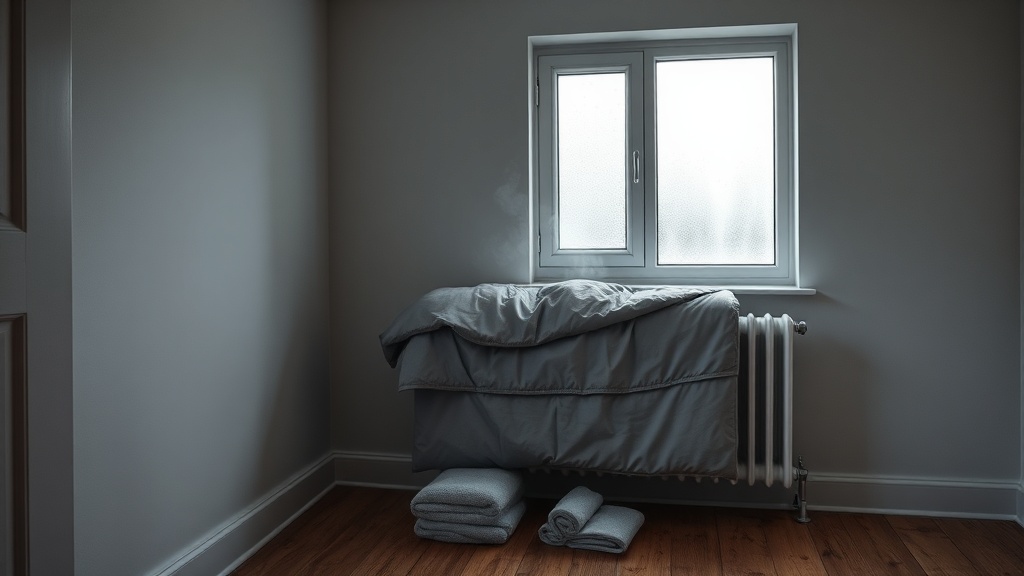
What tends to happen instead is that people dry clothes on radiators, which adds heat without actually removing the moisture from the room. A heated clothes airer is better — it speeds up evaporation and keeps the heat contained to the clothes themselves — but it still releases that moisture into the air. The airer does not suck water out of the air; it just gets your clothes dry faster.
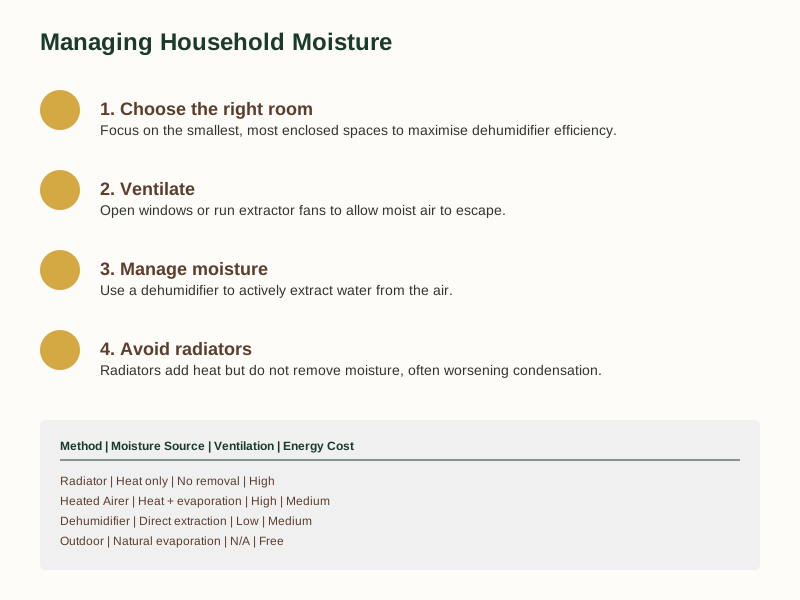
The practical middle ground is micro-climate drying: creating a small, controlled environment for your laundry that is separate from the rest of your home. This means choosing the right room, ventilating it, and managing the moisture load rather than hoping it disperses. For more detail on how to ventilate a room effectively, see our guide: /how-to-ventilate-a-room/
The Three Rules for Safe Indoor Drying
Here is the honest protocol. Follow these three rules and indoor drying becomes a manageable compromise.
Rule 1: Choose the right room.
Dry your laundry in the smallest room in your home — typically a bathroom or a utility room. Keep the door closed while drying. This concentrates the moisture in one space rather than letting it migrate through the whole house. A larger room with the door open just spreads the humidity around, raising moisture levels everywhere instead of containing the problem.
Avoid drying clothes in bedrooms or living rooms if you can. These are the rooms where you spend the most time and where condensation on walls or windows is most likely to be noticed.
Rule 2: Ventilate.
Open a window in the drying room, even just a crack. If you have an extractor fan, use it. The idea is to create a one-way flow: moist air exits, drier air enters from elsewhere in the house. In a bathroom, the window-over-the-shower approach that prevents steam buildup is exactly the same principle — and for exactly the same reason.
If you are drying in a room without a window — a utility room or an internal bathroom — you need mechanical extraction. An extractor fan that vents to the outside is essential. One that recirculates into the loft or just moves air around the room is not doing the job.
Rule 3: Manage the moisture.
This is where a dehumidifier earns its place. Ventilation alone will not remove moisture fast enough in a small, sealed room in winter — the outside air is also cool and damp, so you are not getting much drying effect from an open window when the temperature is 8°C and the humidity outside is 85%.
A dehumidifier pulls water from the air directly. It collects that moisture as liquid water in its tank, which you then pour down the sink. The room stays warmer, clothes dry faster, and the humidity level stays manageable.
A tumble dryer — specifically a vented or condenser dryer — does the same job by routing the moisture outside or condensing it into a tank. A heat pump tumble dryer is more energy-efficient than a standard condenser model and is worth considering if you are in the market for a new machine.
Radiator drying is not a solution. Radiators add heat, which increases the rate of evaporation, but that moisture then sits in the room as humidity. You have traded energy cost for a damp room. If you are going to use a radiator, combine it with a dehumidifier in the same space — the heat speeds drying, the dehumidifier removes the moisture before it settles on walls.
Not sure whether your home already has a moisture problem that needs addressing before you start managing laundry humidity? Get the Free Damp & Mould Diagnosis Checklist to assess your current situation.
Dehumidifiers: Do You Actually Need One?
Here is the honest trade-off.
A dehumidifier is not a luxury if you are regularly drying laundry indoors in a sealed home without mechanical extraction. It is also not a cure-all — it does not fix a leak, it does not replace a broken extractor fan, and it will not compensate for drying clothes in a room with no ventilation. But for the specific, contained problem of managing moisture from indoor laundry drying, it is the right tool for the job.
The alternative — a tumble dryer — removes moisture by venting it outside or condensing it. If you have a working vented or condenser dryer, use it. If you are relying on a dehumidifier, size it correctly. A small unit rated for a bedroom will not keep up with a full load of washing; you need something with enough capacity to handle the moisture load, which for a 6kg load means looking at models in the 10-20 litre per day range.
For regular indoor laundry drying in a flat or small house, two models come up repeatedly in owner feedback: the Meaco Arete One 12L (paid link) and the EcoAir DC12 (paid link).
Check price on Amazon → (paid link)
The Meaco Arete One 12L (paid link) is the one that comes up most often when owners talk about a unit that runs quietly enough to leave on in a utility room or bathroom. Buyers consistently describe it as reliable, compact, and effective at handling laundry loads without the droning fridge-noise that puts people off. The trade-off is the price — it sits at a premium over basic models, and the laundry mode has received some grumbles from owners who find it stops before clothes are fully dry. For a flat or small-to-medium house where condensation is the main issue, it is the unit worth its salt.
If the budget is tighter, the EcoAir DC12 (paid link) is the practical alternative owners turn to. It is effective at pulling moisture, easy to use, and compact enough to manoeuvre on its castors. The common complaint is noise — it is not a bedroom unit, and owners who have tried running it overnight generally wish they had not. The tank design also gets mentioned as a bit awkward. For a utility room or bathroom where you are not trying to sleep, it is the honest budget pick.
For larger homes or persistent damp problems, the Meaco Arete One 20L (paid link) moves up a step in capacity and is consistently described by owners as a “beast” — effective, reliable, and quiet enough for home use, though heavier and less portable.
Running costs are worth knowing: a compressor dehumidifier typically uses 200-400 watts, which is less than a kettle and comparable to a desktop fan heater on a low setting. Over a winter of regular indoor drying, the energy cost is measurable but not alarming — and it is considerably cheaper than dealing with mould treatment or a damp-proofing bill that runs into thousands.
For more on choosing the right dehumidifier for your situation, see our guide: /how-to-choose-a-dehumidifier/
Landlord Responsibilities and Awaab’s Law
If you are a tenant dealing with damp and mould that you believe is caused or worsened by indoor drying — or by a property that simply does not have adequate ventilation — there are specific things you need to know.
Awaab’s Law, which came into force under the Social Housing (Regulation) Act 2023, means that social landlords have a legal duty to investigate and fix dangerous damp and mould within enforced timeframes. This is not guidance or best practice — it is a legal requirement. Private landlords are not covered by Awaab’s Law specifically, but they still have obligations under the Homes (Fitness for Human Habitation) Act 2018 to ensure properties are fit to live in, which includes managing damp and mould.
The important distinction is what caused the problem. Landlords are responsible for structural issues — a leaking roof, penetrating damp through walls, inadequate ventilation that was not installed when it should have been. They are not automatically responsible for condensation caused by tenant behaviour, such as drying clothes without ventilation. However, if the property lacks adequate ventilation (no extractor fan in the bathroom, no trickle vents in the windows), that is the landlord’s responsibility — not yours.
What to do if your landlord is not acting:
- Report the problem in writing — email is fine, but keep records of every communication
- Take dated photographs of any damp or mould
- Give the landlord a reasonable timeframe to respond (typically 14-28 days for non-emergency issues)
- If they do not respond or do not take action, contact your local council’s environmental health or housing standards team — they have powers to enforce
- For advice specific to your situation, contact Shelter or Citizens Advice
A social housing tenant who sent a formal email with photographs of mould to their landlord found that a surveyor was dispatched within 24 hours. Written records and photographic evidence make a significant difference to how seriously a complaint is taken.
If the damp is severe, structural, or you are unsure whether it is condensation or something more serious, get an independent survey before anyone does any work. A surveyor who is not also quoting to do the work will give you an honest diagnosis. See our page on landlord responsibilities for more detail: /landlord-responsibilities/
Frequently Asked Questions
Is it bad for my health to dry clothes indoors?
For most people, the health risk from indoor laundry drying is indirect — it is the damp and mould that can result, not the laundry itself. According to NHS and gov.uk guidance, damp and mould can cause or worsen respiratory problems and trigger asthma, with higher risk for children, older people, and those with weakened immune systems. If you or anyone in your household falls into those categories, managing indoor humidity becomes more important. For the general population, the main risk is to the property rather than to health directly. The practical fix is the same either way: manage the moisture.
Can I dry clothes on a radiator?
You can, but you should not. Radiator drying adds moisture to the room without removing it, which raises humidity and can contribute to condensation on nearby walls. It is also a fire risk if clothes are draped too close to the heater. A heated clothes airer is a better option — it contains the heat and dries clothes faster — but you still need ventilation or a dehumidifier to deal with the moisture it releases.
What is the best temperature to dry clothes indoors?
The warmer the room, the faster evaporation happens. A room at around 18-20°C with an open window and a dehumidifier running is the sweet spot — warm enough to dry clothes reasonably quickly, ventilated enough to carry moisture away, and dehumidified enough that it does not end up on your walls. You do not need to heat the whole house; just the drying room. A small, enclosed bathroom with the door closed, a window cracked open, and a dehumidifier running is a more effective drying environment than a cold living room with everything spread across the furniture.
Indoor Drying Moisture Comparison
| Method | Moisture Source | Ventilation Needed | Energy Cost |
|---|---|---|---|
| Radiator | Heat only, no removal | High | Low (heat) |
| Heated Airer | Heat + evaporation | High | Medium |
| Dehumidifier | Direct extraction | Low | Medium |
| Tumble Dryer | External vent or tank | N/A | Medium-High |
| Outdoor | Natural evaporation | N/A | Free |
Note: This table illustrates the moisture handling capabilities of different indoor drying methods.
Taking the Next Step
The honest answer is that indoor drying is not the problem — unmanaged indoor drying is. A single load of laundry releases around 2 litres of moisture into your home, and in a sealed modern house, that moisture has to go somewhere. The three rules — choose the right room, ventilate, manage the moisture — give you a practical protocol that works with how British homes actually are, rather than how they should ideally be.
If you are worried about damp or mould in your home, or if you want to assess whether your current setup is managing moisture effectively, Get the Free Damp & Mould Diagnosis Checklist to see whether you need to take action.
Related Guides
For a complete overview, see our Why Your House Has Condensation and How to Fix It .
Sources & Further Reading
As an Amazon Associate we earn from qualifying purchases.
Note: The information provided is for general guidance only. Always verify details with a qualified professional or official source.
Buy Meaco Arete One 20L on Amazon → (paid link)
Check EcoAir DC12 price → (paid link)