Is Rising Damp Actually Rare? When to Call a Surveyor
If you’ve been told you have rising damp, you might be wrong. That’s not a comfortable thing to hear when you’re holding a quote for £2,500 worth of chemical damp-proof course injection, but it’s worth sitting with for a moment. The alternative is paying for work you don’t need.
In the UK, rising damp is diagnosed in over half of all damp surveys. Yet it affects a far smaller proportion of properties; industry commentary and surveyor guidance consistently describe it as comparatively uncommon. That gap between diagnosis rates and actual prevalence is the reason this article exists. The honest answer is that most damp problems in British homes are condensation, a leaking pipe, or poor ventilation—and those are all fixable for a fraction of the cost of a damp-proof course. This piece cuts through the sales pitch to explain why rising damp is genuinely rare, how to tell whether you actually have it, and when you need a professional surveyor rather than a damp-proofing contractor.
Why Rising Damp Is Over-Diagnosed
The starting point is a definition. The Royal Institution of Chartered Surveyors (RICS) defines damp as excess moisture that should not be present in a building. That’s a broad church, and deliberately so, because damp is a symptom, not a single disease. The moisture in your wall might be arriving by several routes: condensation from humid indoor air, water penetrating from outside through a defect, a leak, or—in a small number of cases—water rising up through the masonry from the ground.
That last one is rising damp, and here is the uncomfortable gap: it is diagnosed frequently, but it occurs far less often than the diagnosis rate implies. Industry commentary and surveyor guidance describe it as relatively uncommon, while damp-proofing companies—whose revenue depends on finding it—tend to find it more often than independent professionals might. The reason is straightforward: a chemical damp-proof course injection is a high-margin, repeatable revenue line. If your business model requires finding rising damp, you’ll develop a practised eye for it.
What you almost certainly have instead is condensation. The UK’s climate makes it the most common cause of damp in British homes—not because of any failure on your part, but because modern living generates enormous amounts of water vapour, and modern homes are far more airtight than the draughty Victorian stock they replaced. Cooking, showering, drying clothes indoors, even breathing—all of it adds moisture to air that has nowhere to go once the windows stay shut. That is the problem in most cases, and it is the problem a damp-proofing contractor won’t fix with an injection.
The practical implication is simple: before you accept any quote, you need to know what you’re actually dealing with. Our guide to condensation vs damp walks through the key differences, but the short version is that condensation tends to appear on cold surfaces, particularly north-facing walls, around windows, and in poorly ventilated rooms. It comes and goes with the seasons. Rising damp, if it occurs, is persistent and starts at floor level.
The Three Conditions for Rising Damp
Here is the bit that matters most. Genuine rising damp requires three specific conditions to be present simultaneously. If any one of them is absent, rising damp is physically impossible in that wall.
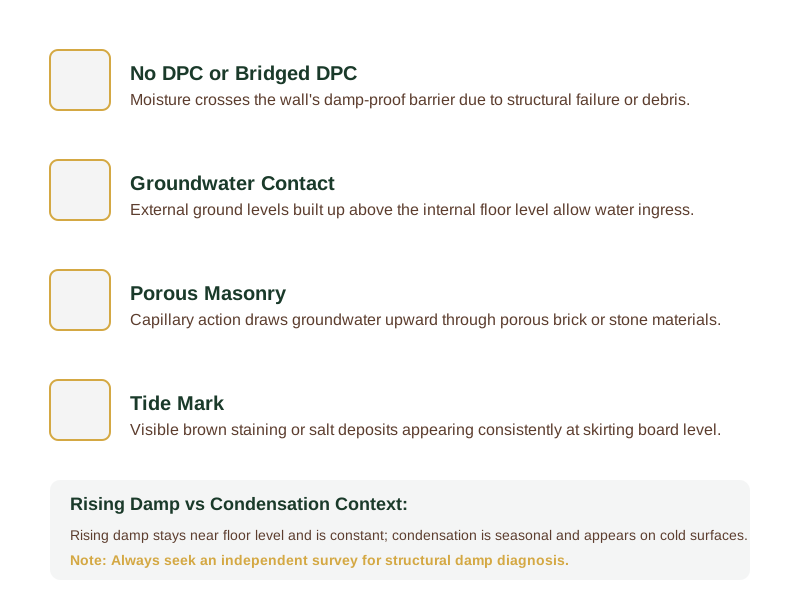
Condition one: no effective damp proof course, or one that has been bridged. A DPC is a horizontal barrier—usually a physical sheet or a chemical cream injected into mortar—designed to stop moisture from the ground climbing up through capillary action. Most UK properties built after about 1900 have one. If yours was built before that, or if the DPC has been bridged by soil, a raised patio, or a thick layer of render touching the ground, moisture can cross it. But if your property has an intact DPC and nothing bridging it, rising damp from below is structurally prevented.
Condition two: groundwater in direct contact with the wall. This sounds obvious, but it matters. In a typical UK terrace with solid foundations, a clear air gap, and modern drainage, groundwater isn’t usually pressing against the internal wall. It is outside, managed by the ground level, the drainage, and the construction itself. Rising damp is most likely to occur where the external ground level is higher than the internal floor, where there is no effective damp proof membrane, or where the property sits on a high water table—none of which apply to most urban UK homes.
Condition three: porous masonry. Brick and stone can draw water upward through their pores. Modern cavity walls cannot; the cavity acts as a deliberate break, and even if the outer leaf draws moisture, it stops at the inner leaf. Most UK homes built from the 1930s onwards are cavity wall construction. If your property has a cavity wall, rising damp is structurally impossible regardless of what a damp survey says. The moisture has to be coming from somewhere else.
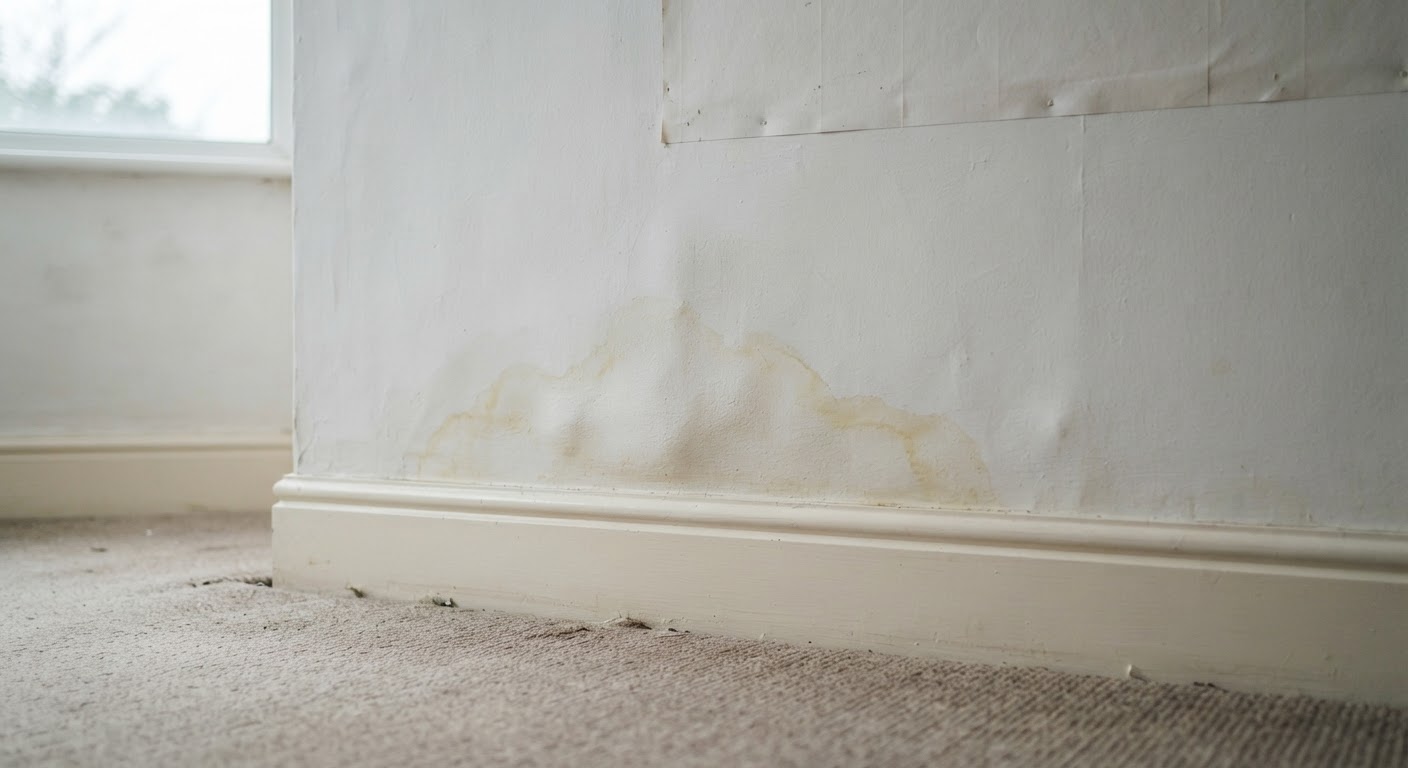
The “tide mark” that damp-proofing salesmen point to—that distinctive brownish staining that climbs up from the skirting board—is frequently cited as proof of rising damp. But a tide mark has other explanations. Old chimney breasts leave hygroscopic salts in the masonry that draw moisture from the air and leave staining. Leaking pipes—including waste pipes, central heating pipes, and radiator feeds—can create exactly the same pattern. Even condensation over many years can leave a deposit at skirting level if the room has been consistently cold and humid. None of these require a damp-proof course.
This matters because it changes the fix entirely. A leaking pipe needs a plumber. Hygroscopic salts need the source moisture sorted and possibly the plaster replaced with salt-resistant board. Condensation needs ventilation and humidity management. None of them are fixed by injecting a chemical DPC into a wall that doesn’t need one.
How to Tell If It’s Rising Damp (or Something Else)
You can do a reasonable first-pass assessment yourself, before spending money on a surveyor. The key is looking at where the dampness is, how high it reaches, and what pattern it forms.
Rising damp typically presents as a tide mark—a horizontal band of staining and dampness starting at the skirting board and rarely climbing above one metre. It is often accompanied by salt crystallisation on the surface, which looks like a white or grey powdery deposit. The dampness is persistent: it doesn’t come and go with the weather, and it doesn’t improve significantly with better ventilation.
Condensation behaves differently. It appears as patchy dampness on cold surfaces—the corners of windows, the ceiling, the back of external walls—and it varies with the season. It is worst in winter when surfaces are cold and indoor moisture production is highest. Wipe the surface dry and it returns within hours on a cold day. Black mould often accompanies it in the worst spots, particularly where air circulation is poor: behind furniture, in corners, on north-facing walls.
A leak is usually the easiest to identify because it is localised. Water damage near a pipe joint, under a window, below a roof valley, or around a bathroom fitting is a strong signal. The pattern is often a stain that spreads downward or outward from the source. If you’ve had recent plumbing work, a blocked gutter, or a storm, those are worth investigating before you call a damp specialist. Our guide to how to tell condensation rising damp has more detail on the diagnostic steps.
There is one rule worth remembering above all others: if the dampness is noticeably above one metre from the floor, it is almost certainly not rising damp. Physics limits how high capillary action can draw water—the pressure differential simply isn’t strong enough to push it much beyond that height without an active water source. A damp patch at chest height on an internal wall is a leak or condensation. A tide mark at the skirting board is worth investigating further, but it is still more likely to be salts or a bridged DPC than genuine rising damp.
When You Actually Need a Surveyor
The honest answer is: less often than the damp-proofing industry would have you believe. But there are situations where a proper independent survey is the right move.
Call an independent surveyor—not a damp-proofing contractor who also surveys—if you have a persistent tide mark at skirting level, visible salt crystallisation, and your property predates 1900 or has a known missing DPC. You are looking for someone who charges for their time rather than one who offers a free survey and then quotes for the work. The Property Care Association (PCA) maintains a directory of independent surveyors who have no financial interest in what they find. That is the route worth taking.
Call a plumber if you suspect a leak. Check visible pipework first—under sinks, around the boiler, in the airing cupboard. Look for corrosion, drips, or damp patches that correspond to pipe runs. If you can hear water running when nothing is in use, or if your water meter is moving when everything is turned off, that is a leak somewhere in the system. Our ventilation guide covers the steps to manage condensation yourself while you arrange a professional assessment.
If the dampness varies with the weather, appears on cold surfaces, and improves with better ventilation, you probably don’t need either. The fix is ventilation, humidity management, and—in persistent cases—a dehumidifier sized correctly for the room. That is a fraction of the cost of a damp-proof course, and it is fixable without anyone drilling holes in your walls.
Now you know what to look for—Get the Free Damp & Mould Diagnosis Checklist . It covers the key diagnostic questions to ask before you accept any quote, and it gives you a structured way to describe what you’ve found to a surveyor or contractor. That matters, because the description you give shapes the diagnosis you get.
Frequently Asked Questions
Can rising damp be cured without a damp-proof course?
In theory, yes—a physical damp proof membrane or a tanking system can prevent moisture rising through masonry. But these are invasive, disruptive, and expensive. If the dampness is condensation, a leak, or hygroscopic salts rather than genuine rising damp, none of that work addresses the actual cause. The honest answer is that most cases diagnosed as rising damp don’t require any DPC work at all.
Is it safe to paint over damp walls?
No. Painting over damp walls traps the moisture behind the paint film, which creates the perfect conditions for mould to grow unseen behind the surface. It will come back, often more aggressively. You need to identify and fix the source of the moisture first—then treat any remaining surface mould with a proper fungicidal wash—before you repaint.
What is Awaab’s Law?
Awaab’s Law is a UK housing law introduced after Awaab Ishak’s death highlighted serious failures in how social landlords handle damp and mould complaints. It requires social landlords to investigate and repair serious hazards like damp and mould within set timescales. If you’re a social tenant and your landlord has not acted on a damp and mould complaint, the law now gives you stronger grounds to push for a response. Tenants in private rented accommodation can contact their local council’s environmental health team or Citizens Advice for support.
Rising Damp vs Condensation: Key Differences
| Feature | Rising Damp | Condensation |
|---|---|---|
| Location | Starts at skirting board | Cold surfaces, corners, windows |
| Height | Rarely above 1 metre | Can appear anywhere |
| Persistence | Constant | Varies with weather/season |
| Fix | Damp-proof course (if needed) | Ventilation and humidity control |
Taking the Next Step
The headline is straightforward: rising damp is rare, and most damp problems in UK homes are condensation, a leak, or poor ventilation. If you’ve been told you need a damp-proof course, the honest next step is to check whether your property meets the three physical conditions that make rising damp possible—and to get an independent survey before committing to any work. That independent assessment costs a few hundred pounds and could save you thousands on unnecessary treatment.
If you’re still working out what you’re dealing with, Get the Free Damp & Mould Diagnosis Checklist . It walks you through the key diagnostic questions, helps you describe what you’ve found clearly, and gives you something concrete to take to a surveyor or contractor. It is the step that sits between “I’m not sure what’s wrong” and “here’s what needs to happen next.”
For tenants in social or private rented housing: if your landlord has received a written report of damp and mould and hasn’t acted, Awaab’s Law and the Housing Health and Safety Rating System give you real grounds to escalate. Contact Shelter, your local Citizens Advice, or your council’s environmental health team—they can advise on the specific route for your situation. You don’t have to accept a damp property as normal.
Related Guides
For a complete overview, see our Is It Condensation, Rising Damp or a Leak? How to Tell the Difference .
Sources & Further Reading
Note: General guidance only. Always verify details with a qualified professional or official source.