Why Surveyors Disagree on Rising Damp and What That Means for You
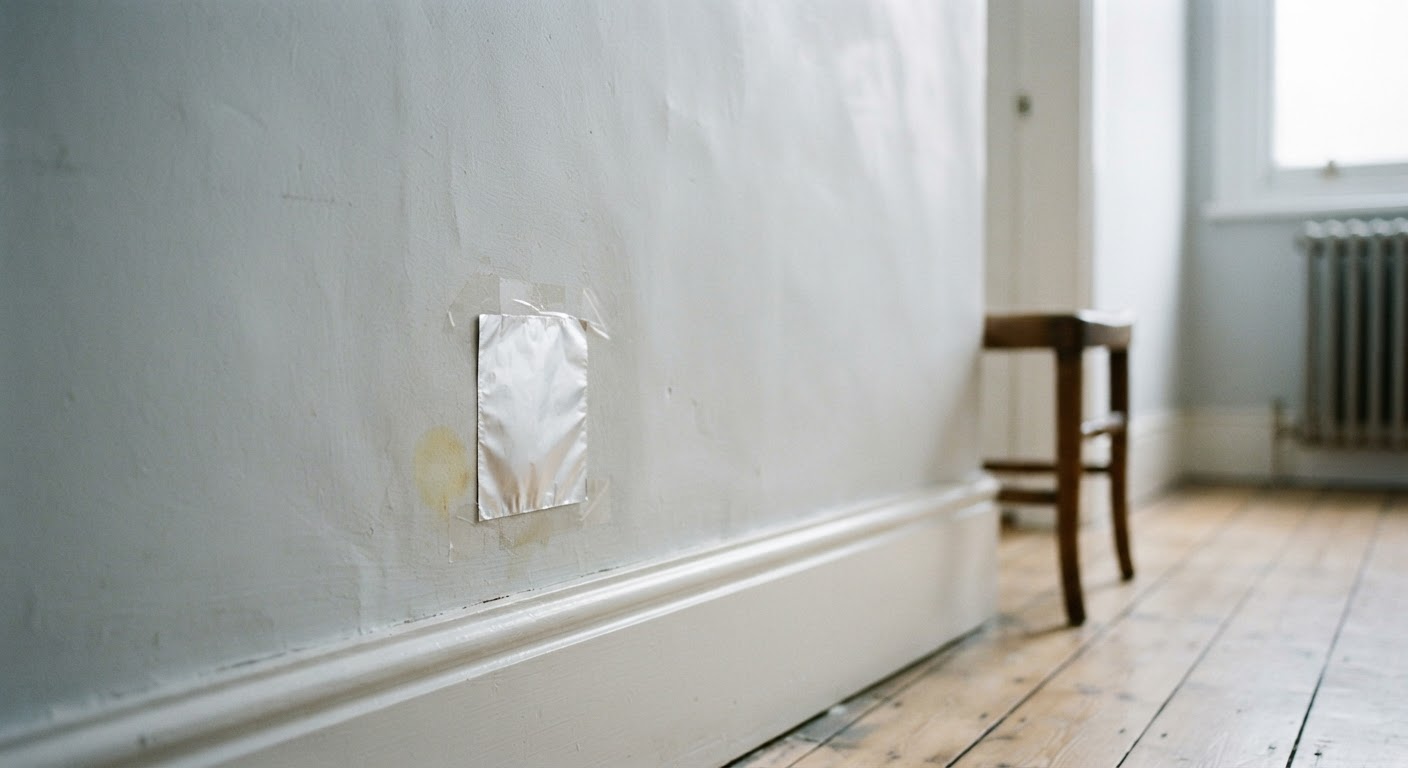
A surveyor hands you a report with a moisture meter reading of 18% against your ground-floor wall and tells you it’s rising damp. The quote for plaster removal, salt treatment, and re-plastering lands at £2,500. Another surveyor, using the same type of meter, tells you the wall is dry. This is not a rare disagreement; it is the single most common source of conflict in UK property diagnostics, and the reason lies entirely in the limitations of the tool everyone relies on to make the call.
This article explains why the disagreement happens, what the proper test actually is, and what you should do before agreeing to any expensive work.
What Rising Damp Actually Means
Rising damp is the vertical movement of water from the ground up through porous building materials—brick, stone, or mortar—by capillary action. Think of it like a paper towel dipped into a glass of water: the liquid climbs the fibres until it hits a barrier. In a wall, that barrier is meant to be the damp-proof course (DPC), a physical layer inserted at construction that stops moisture reaching the brickwork above. British building regulations have mandated DPCs in new-build properties since around 1875, and BS 6576 sets out the recognised specification for chemical DPC installations in existing walls.
The standard surveyor protocol for checking rising damp involves three things: confirming whether a DPC was installed at all (properties built before 1950 often lack one), running a handheld moisture meter across the wall, and looking for the characteristic “tide mark”—a band of efflorescent salts deposited where moisture has evaporated from the plaster surface. If all three align, the textbook diagnosis is rising damp.
The problem is that the meter reading is doing a lot more work than the protocol admits.
Why Surveyors Disagree: The Salt Contamination Problem
Handheld capacitance moisture meters work by measuring electrical resistance across a surface. Lower resistance reads as higher moisture. The trouble is that electrical resistance drops just as readily in the presence of hygroscopic salts—compounds that draw moisture from the air and hold it on the wall surface. These salts accumulate in plaster from entirely innocent sources: old chimney soot bleeding through from the other side of a party wall, nitrates from fertiliser in the soil against a garden wall, or de-icing salts tracked in on footwear from a garage floor.
The result is a false positive so common that the building science literature has a specific name for it. A wall can read 18% on a moisture meter—well above the threshold most surveyors treat as “damp”—while being genuinely dry. The salts themselves hold enough surface moisture to mislead the instrument entirely. BRE Digest 245, the authoritative UK reference on rising damp diagnosis, warns about this limitation and recommends a more rigorous confirmation test before any damp-proofing work is specified.
When one surveyor says your wall is damp and another says it’s dry, the honest explanation is often that they are both reading the same meter correctly—but the meter is telling them about salts, not water. The disagreement is not about competence. It is about whether anyone bothered to run the test that distinguishes the two.
The Definitive Test Most Surveyors Skip
The test that actually separates water from salts is the calcium carbide (CM) test. It involves drilling a small hole into the plaster, collecting a sample of the dust, sealing it in a steel vessel with calcium carbide powder, and measuring the pressure of acetylene gas produced when any moisture present reacts with the carbide. More moisture means more gas, and the pressure reading converts directly to a moisture content percentage. Crucially, salts do not react with calcium carbide—only water does.
This is the only test that gives a definitive answer about whether the wall actually contains moisture. BRE Digest 245 recommends CM testing to confirm any moisture meter finding before specifying remedial work.
Why do most surveyors skip it? It requires specialist equipment, a trained operator, and time—you are not getting an answer on the doorstep. It also costs more than waving a meter across the wall for thirty seconds. For a surveyor whose business model includes selling the remedial work they diagnose, the cheaper, faster meter reading has a commercial logic that the definitive test does not share.
This is the gap between the textbook protocol and the commercial reality. It explains almost every case where two surveyors give wildly different verdicts on the same wall. The diagnosis of rising damp is not always a scientific finding; sometimes it is a commercial decision dressed up as one. That doesn’t mean every surveyor is acting in bad faith, but it does mean a meter reading alone should never be enough to authorise £2,500 of plaster removal.
Before agreeing to any damp-proofing quote, ask whether the diagnosis was confirmed with a Calcium Carbide test. If the answer is no, you have every right to question the finding.
If you want a checklist of exactly what to ask your surveyor before accepting any quote, we have put one together: Get the Free Damp & Mould Diagnosis Checklist .
The Real Culprits: Condensation, Leaks, and Missing Ventilation
Government guidance on damp in UK homes is clear: rising damp is frequently diagnosed where the real problem is condensation, a leak, poor ventilation, or cold surfaces. The RICS consumer guide on damp and mould recommends finding and fixing the moisture source, improving ventilation, and addressing heating and insulation before spending money on damp-proofing measures. Their guidance also notes that certain surveyors and building academics consider genuine rising damp to be extraordinarily rare outside laboratory conditions, and that the UK’s older housing stock makes it more likely that a damp patch at ground level has a different cause altogether.
A cold north-facing wall that stays below the dew point when you cook or shower with the door closed is going to condense moisture regardless of what is happening underground. A leaking pipe hidden behind a skirting board can saturate the base of a wall for months before anyone notices the stain on the plaster. Condensation tends to leave tell-tale signs—it appears on glass, in corners, behind furniture, and on surfaces you breathe on—rather than climbing uniformly up a wall from the ground. Rising damp, if it occurs at all, follows a different physical pattern tied to the DPC level.
RICS explicitly warns against expensive damp-proofing measures before routine maintenance and cause-finding have been carried out. That means checking that extractor fans work and vent to the outside, that trickle vents haven’t been painted shut, that windows can be opened, and that the heating isn’t being used as a substitute for ventilation. For tenants, the route is straightforward: report the problem to your landlord in writing, keep copies, and if it isn’t resolved, contact the local council’s environmental health team.
A Stakes-Weighted Approach to the Decision
The question isn’t “is rising damp real?"—it is, in principle—but “is this wall actually experiencing it, or is something else going on?” The stakes of getting this wrong are high: you are either spending £2,500 on unnecessary work, or you are leaving a genuine moisture problem untreated while it gets worse behind the plaster.
The practical call is this: if the surveyor’s diagnosis rests on a moisture meter reading alone, with no corroborating evidence—no physical breach in a confirmed DPC, no confirmed leak, no saturation pattern that matches rising damp specifically—then reject the diagnosis and seek a second opinion that includes CM testing.
Flip to accepting the diagnosis only if there is corroborating physical evidence: a confirmed DPC that has been bridged or physically damaged, a confirmed water source at ground level, or a saturation pattern consistent with capillary action rather than condensation or a leak.
For a tenant, the cost calculus is different. You are not paying for remedial work yourself—your landlord is. Under Section 11 of the Landlord and Tenant Act 1985, your landlord has a statutory duty to keep the property in repair, and this applies regardless of the specific diagnosis. A damp wall that turns out to be condensation still needs fixing—you just push for ventilation and extraction improvements rather than a damp-proof course. The Housing Ombudsman has found landlords in breach for treating damp symptoms without addressing the underlying cause. The route for a tenant is always the same: report it in writing, escalate to environmental health if it isn’t resolved, and don’t let anyone tell you the problem is fine because “it’s just condensation.”
Frequently Asked Questions
Is rising damp real?
Yes, rising damp—vertical movement of moisture through a wall by capillary action—is recognised in British building standards. However, it is far less common than the damp-proofing industry suggests. Many cases diagnosed as rising damp turn out, on proper testing, to be condensation, salt contamination, or a leak. The disagreement about how common it actually is forms the basis of this whole problem.
How can I tell if my damp is actually rising damp?
Ask whether the diagnosis was confirmed with a Calcium Carbide test. Check whether the property has a DPC at all—pre-1950 properties frequently don’t. Look for a physical breach in the DPC (often visible at the base of a wall where the render has been rebuilt to the ground), and check whether the damp pattern matches capillary rise (climbing uniformly from the base) rather than condensation (appearing on cold surfaces, corners, or behind furniture). If the surveyor is relying solely on a moisture meter reading, that is not sufficient evidence.
Can I treat rising damp myself?
No. Rising damp involves the structural fabric of the building, and any remedial work—whether a new DPC, replastering with salt-resistant materials, or tanking—needs to be specified and carried out by qualified contractors. What you can do yourself is rule out the simpler causes first: check ventilation, open windows, use an extractor fan, and monitor the wall with a hygrometer. If the damp persists after ventilation has been addressed, get a proper independent survey before anyone starts removing plaster.
I’m a tenant—what are my rights?
Your landlord is responsible for keeping the property in repair under Section 11 of the Landlord and Tenant Act 1985, regardless of the specific diagnosis. Report the problem in writing, keep copies, and if it’s not resolved within a reasonable time, contact your local council’s environmental health team. They have enforcement powers under the Housing Health and Safety Rating System. For social housing tenants, Awaab’s Law requires faster resolution of damp and mould cases. You don’t need to accept “it’s just condensation” as an acceptable answer—condensation still needs fixing.
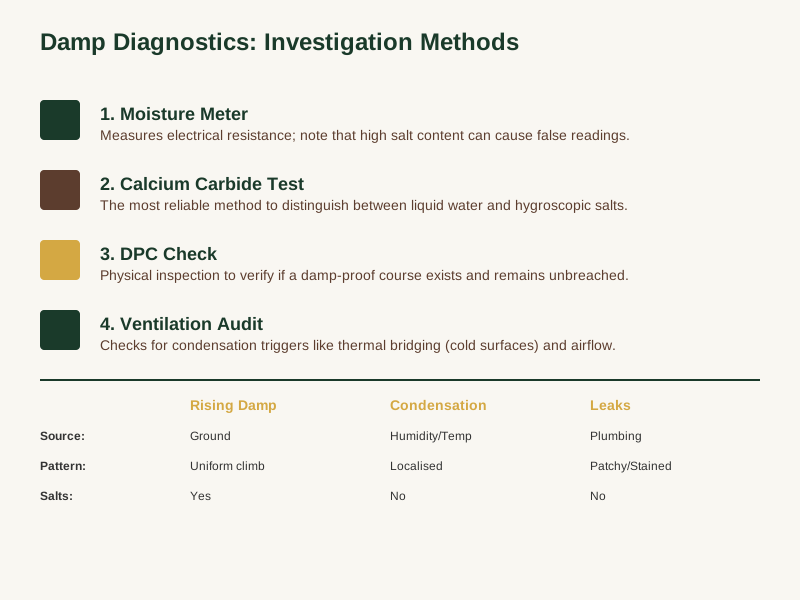
Damp Diagnosis: Key Indicators
| Indicator | Rising Damp | Condensation | Leaks |
|---|---|---|---|
| Source | Ground moisture | Humidity / Temperature | Plumbing / Structure |
| Pattern | Uniform climb from base | Localised / Cold surfaces | Patchy / Stained |
| Salt deposits | Yes | No | No |
| DPC breach | Often required | Not applicable | Not applicable |
Taking the Next Step
The disagreement between surveyors on rising damp is the predictable consequence of using a tool that can’t distinguish between water and salts, and of commercial incentives that favour a fast diagnosis over a definitive one. The fix isn’t complicated: either the diagnosis was confirmed with a CM test, or it wasn’t. If it wasn’t, you haven’t been given evidence—you have been given an expensive quote.
Before you accept any damp-proofing quote, make sure you have that checklist in front of you. It is designed to be the set of questions that separates a proper diagnostic survey from a commercial sales visit: Get the Free Damp & Mould Diagnosis Checklist .
If you are a tenant and the damp hasn’t been acknowledged or addressed after you reported it in writing, don’t let the debate about rising damp become a reason to do nothing. The landlord’s obligation exists regardless of the diagnosis, and the local council’s environmental health team can act on your behalf if needed.
Related Guides
For a complete overview, see our Is It Condensation, Rising Damp or a Leak? How to Tell the Difference .
Sources & Further Reading
- Building Research Establishment (BRE)
- Royal Institution of Chartered Surveyors (RICS)
- UK Government - Building Regulations
Note: This information is for general guidance only. Always verify details with a qualified professional or official source.