Mould in Children's Bedrooms: NHS Guidance and What to Do

As an Amazon Associate we earn from qualifying purchases. This page contains affiliate links — if you buy through them, we earn a small commission at no extra cost to you.
Black patches have started spreading across the bedroom wall behind your child’s cot, and the internet isn’t much help sorting out how worried to actually be — half the results wave it away, the other half reach for frightening language the NHS itself doesn’t use. Neither is useful.
What is useful is knowing what actually drives the risk, what you can handle yourself, and what genuinely needs a professional. That’s what this article is for. By the end, you’ll have a clear, ordered list of what to do — and crucially, in what order — so you stop the cycle of cleaning the patch and watching it come back.
Why a Child’s Bedroom is a High-Risk Zone
Not all rooms are equal when it comes to damp and mould. A child’s bedroom warrants particular attention, and the reason isn’t complicated — it’s physics and biology working together.
Children breathe faster relative to their body weight than adults do. That higher respiratory rate means they inhale more air — and more of whatever’s in it — per kilogram of body weight. Their immune systems are also still developing, which means their bodies are slower to mount a defence against airborne allergens and spores. And then there’s the time factor: young children spend a disproportionate amount of their day in their bedrooms, often with the door closed and the window shut tight against the cold.
UK public health guidance is consistent on this point: damp housing is flagged as a significant risk factor for childhood respiratory illness, with young children — under-fives especially — treated as a higher-priority group for mould remediation because of their developing lungs and immune systems. That isn’t alarmist language — it’s a clinical assessment of relative vulnerability.
Research from Bradford has added weight to this picture, finding a measurable association between visible damp and mould in bedrooms and increased rates of wheeze and allergic conditions in children. The pattern is consistent: the bedroom is where the risk concentrates, because that’s where children are most exposed, for the longest stretches, during the years when their lungs are most impressionable.
The practical implication is straightforward. When you find mould in your child’s room, it isn’t just a cosmetic problem or a cleaning job. It’s the highest-stakes location in the house for this particular issue, which means the response has to be more thorough than a wipe and a hope.
If you’re not sure whether what you’re dealing with is condensation rather than a leak or rising damp, it’s worth getting that right before you do anything else — the fix is completely different. Get the Free Damp & Mould Diagnosis Checklist to walk through the key points.
The Three-Step Response: Clean, Fix, Check
Here’s where most parents go wrong — and it’s not their fault, because the advice they find online tends to treat cleaning and fixing as the same job. They’re not.
The honest approach breaks down into three distinct steps, in this order:
Step 1 — Clean the mould. Remove what’s visible to stop your child breathing in spores right now. This is necessary but not sufficient.
Step 2 — Fix the damp source. This is the one-off hard job that actually solves the problem. Without it, the mould comes back — usually within a season.
Step 3 — Check with a doctor if needed. If your child has asthma, eczema, or any respiratory condition, surface cleaning and damp fixes are part of the picture, but a clinician needs to assess the health side.
The logic here is stakes-weighted: the cost of skipping Step 2 — of cleaning without fixing — is ongoing exposure for a child whose lungs are still developing. That’s the cost of failure that matters most. Cleaning alone is the repeat-every-few-weeks option; fixing the source is the one-off job that ends it.
You can see the split clearly when you think about what each option actually does. Surface cleaning physically removes the spores from the immediate environment, which matters for today’s exposure. But it does nothing to the underlying moisture conditions, so the mould will regrow as soon as the conditions allow. Fixing the source — whether that’s a condensation problem, a leak, or poor ventilation — removes the conditions that allow mould to grow in the first place. It’s harder and takes longer, but it’s the job that doesn’t need doing again.
The one situation where you’d flip to cleaning-as-the-priority is if the underlying damp is already being resolved by a landlord or housing association, and you’re waiting for work to start. In the meantime, keeping the surface clear reduces exposure while the root cause is being addressed. But even then, cleaning is buying time — it’s not the plan.
How to Clean Mould Safely (Without Making It Worse)
Right, let’s get the cleaning done properly. The aim is to kill and remove the mould without spreading spores into the air your child breathes.
The standard approach for hard, non-porous surfaces (paint, plaster, tiles, glass) is a diluted bleach solution — one part bleach to ten parts water — or a dedicated mould remover such as HG Mould Remover (paid link), which owners consistently report works fast and with minimal scrubbing. The trade-off is the smell: HG has a strong chlorine odour, and you’ll want the room well-ventilated and a window open while you work. A pair of rubber gloves and a basic dust mask are the minimum PPE — don’t skip them.
What you absolutely should not do is sand or scrape dry mould off a surface. That releases spores into the air you’re trying to protect your child from inhaling. Work wet.
On porous surfaces — wallpaper, bare plaster, soft furnishings — bleach solutions are less effective because they don’t penetrate deep enough. The mould roots sit below the surface and will grow back through. For these situations, a fungicidal wash designed for the job (products from HG or Unibond are widely available in the UK) does a better job than diluted bleach. Soft furnishings and curtains that have gone mouldy are often best laundered or, if the item is old and heavily affected, replaced rather than cleaned.
And please, whatever you do — do not paint over damp mould with anti-mould paint and call it sorted. Anti-mould paint is a supplementary measure at best. Painting over damp mould traps moisture inside the wall structure, and the mould will grow back through the paint layer, often faster than before. The anti-mould paint catches a small amount of surface condensation; it cannot fix a damp wall.
One more thing worth knowing: after cleaning, if the wall surface is stained, let it dry fully before applying any treatment or paint. Moisture meters are useful here — you want the reading well below the threshold before you close the wall back up. Something like the ThermoPro TP50 (paid link) is a reasonable basic hygrometer for checking whether humidity is coming down after cleaning and dehumidifier use, though it has no backlight and won’t send alerts to your phone.
See current price on Amazon → (paid link)
For a full walkthrough of removal products and their relative strengths, see our guide to how to clean mould safely .
Fixing the Source: Ventilation and Damp Control
Cleaning the mould is step one. Now comes the job that actually ends it.
In the vast majority of UK children’s bedrooms, the culprit is condensation. Here’s why: modern double glazing and draught-proofing have sealed up the gaps that used to ventilate British houses naturally. Warm, moisture-laden air from breathing, sleeping, and everyday life hits a cold surface — a north-facing wall, a single-glazed window, the corner where a wardrobe sits against an external wall — and the moisture condenses out. Mould spores, which are everywhere, land on that damp surface and grow.
The fix is straightforward in principle:
Low-cost measures worth trying first
- Open a window for ten to fifteen minutes every morning — even five minutes makes a difference. It’s a bit of a faff in January, but it works.
- Leave the bedroom door open when the child is out of the room, to allow air circulation.
- Use an extractor fan if the house has one — and check it’s actually venting to the outside, not into the loft.
- Keep a background heat on in the bedroom, even at night. A consistently warm room is less prone to condensation than one that heats up sharply in the morning and goes cold at night.
- Avoid drying clothes on radiators in the bedroom — that adds a significant amount of moisture to the air.
What a dehumidifier actually does
A dehumidifier can help accelerate the drying-out process and keep humidity down in a poorly ventilated room. But — and this is important — it’s a management tool, not a fix. If the underlying cause is a structural issue or a leak, a dehumidifier is just papering over the cracks. For a child’s bedroom with condensation problems, a compressor dehumidifier rated for the room size will pull moisture out effectively, though it can be noisy on higher settings — something to consider if you’re running it overnight.
When it’s not condensation
If the damp is coming from a leaking pipe, a roof problem, or a suspected rising damp issue, low-cost ventilation measures will help but won’t resolve it. These situations need an independent survey — not a free quote from a firm that also does the work, which is an obvious conflict of interest. Look for a surveyor who is a member of the Property Care Association. It’s also worth knowing that landlords are responsible for fixing structural damp, so if you’re a tenant, this is their job — more on that in the next section.
Our guide to how to reduce condensation in bedroom covers the full range of options with more detail on what works in different property types.
When to Call a Professional or Doctor
Some situations are beyond the scope of DIY, and this is one of them.
Call a professional damp surveyor if:
- The mould returns repeatedly despite thorough cleaning and ventilation improvements
- You can see water coming through walls or ceilings
- The damp patch is large — generally above about 1m × 1m — or spreading behind plaster
- You suspect a hidden leak or rising damp rather than condensation
If your child has asthma or another existing respiratory or immune condition, or if you’re worried about how they’re doing generally, that’s a conversation for a GP — not something to work out from a list on a website. NHS guidance is clear that damp and mould can cause or worsen respiratory problems and allergic reactions, and that this matters more for children, older people, and anyone with a weakened immune system. That’s the honest framing — not “toxic mould” or alarming language, but a real risk that’s worth acting on promptly rather than diagnosing yourself.
For tenants — your landlord has to act
If you rent and you’ve found mould in your child’s bedroom, this isn’t your responsibility to fix alone. Your landlord has a legal duty to address damp that affects the health of occupants, and under Awaab’s Law — the housing standards framework that followed the tragic case of Awaab Ishak — they are expected to act urgently, without waiting for medical evidence.
Report it in writing. Keep copies. If the landlord doesn’t respond, contact the council’s environmental health team or seek advice from Shelter or Citizens Advice. The gov.uk guidance is unambiguous: landlords shouldn’t blame tenants for damp conditions. Verbal complaints can be ignored; written ones are harder to dismiss.
If you’re a tenant dealing with this, our page on tenants rights damp mould has a fuller breakdown of what to do and who to contact.
Frequently Asked Questions
Is black mould in a child’s bedroom dangerous?
It can worsen breathing problems, particularly in children who already have asthma or other respiratory conditions, and it can trigger allergic reactions. It is not “toxic mould” in the way some online myths describe, but it is a genuine health concern that should be addressed — not left. The risk is real enough to warrant urgency, even if the internet makes it sound more dramatic than it needs to be.
Can I just paint over the mould with anti-mould paint?
No. You must clean the mould first, and you must address the underlying moisture source. Anti-mould paint is a supplementary measure for light condensation — it cannot fix a damp wall, and painting over damp mould will cause the mould to grow back through the paint layer. It’s a waste of money and a delay in fixing the real problem.
Is it my fault if my home has mould?
No. Damp and mould in rented homes are the landlord’s responsibility. Even in owner-occupied homes, condensation mould is often a consequence of modern building standards — sealed windows, reduced natural ventilation — rather than anything you’ve done wrong. If you’re a tenant and someone has suggested otherwise, that is not accurate. Get advice from Citizens Advice or Shelter.
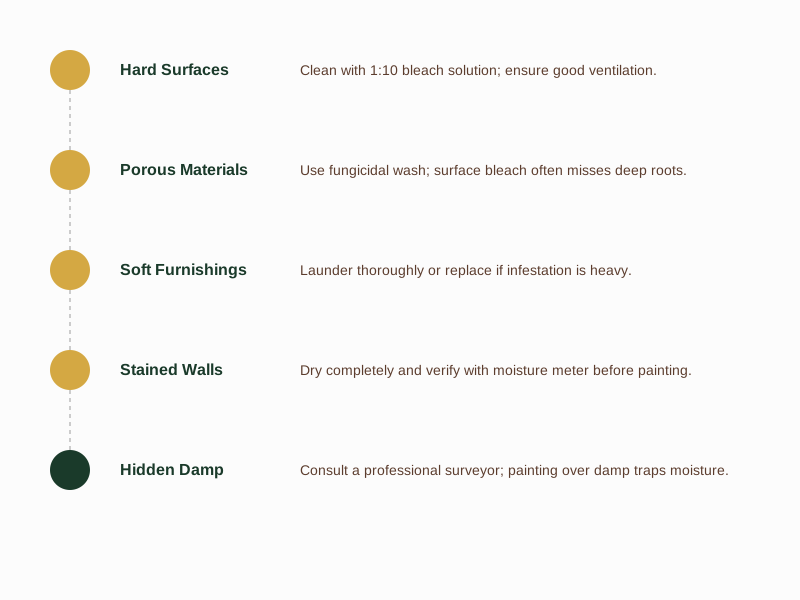
Mould Removal Surface Guide
| Surface Type | Recommended Action | Key Consideration |
|---|---|---|
| Hard (Paint, Tiles, Glass) | Diluted bleach solution (1:10) or dedicated mould remover | Ensure room is well-ventilated; wear gloves and a dust mask |
| Porous (Wallpaper, Plaster) | Fungicidal wash (e.g., HG or Unibond) | Bleach may not penetrate deep enough; roots may regrow |
| Soft Furnishings (Curtains) | Launder or replace if heavily affected | Old items are often best replaced rather than cleaned |
| Stained Walls | Let dry fully before repainting | Use a moisture meter to ensure wall is dry before sealing |
| Hidden Damp | Call a professional damp surveyor | Painting over damp mould traps moisture and worsens the issue |
Taking the Next Step
The job breaks down into a clear sequence: clean the mould today to stop your child breathing in spores right now, fix the underlying damp to end it properly, and check with a doctor if your child has any existing respiratory vulnerability. Cleaning without fixing the source is the most common mistake, and it’s the one that leads to months — sometimes years — of recurring patches and worry.
That checklist will help you work through the diagnosis systematically, so you know whether you’re dealing with condensation (the most common), a leak, or something that needs a survey. Grab it before you spend money on treatments that won’t work if you haven’t got the right diagnosis.
Related Guides
For a complete overview, see our What Does the NHS Actually Say About Mould in Your Home? .
Sources & Further Reading
As an Amazon Associate we earn from qualifying purchases.
Note: General guidance only. Always verify details with a qualified professional or official source.
Buy HG Mould Remover on Amazon → (paid link)