What Dehumidifier Running Costs Actually Look Like in the UK
Black mould returns every winter. Your instinct is to reach for the repaint. But before you spend £300 on emulsion and a weekend sanding down walls, there’s a number worth knowing: roughly £40 a year to run a dehumidifier properly. It’s a figure that often surprises people, as the myth that these machines are electricity guzzlers is everywhere.
The honest answer is that a dehumidifier costs less to run than most people assume, and significantly less than the damage it prevents. Here is what the numbers look like in a UK home.
How Electricity Costs Are Calculated in the UK
To understand what a dehumidifier costs to run, it helps to know the basic math behind any appliance.
Electricity is billed in kilowatt-hours (kWh) — that is 1,000 watts running for one hour. Your supplier charges you per kWh: roughly 24p on most UK tariffs in 2024, though this varies by region and provider. What trips people up is that a dehumidifier doesn’t draw its maximum power continuously. It cycles on when humidity is above the set point and off once it’s reached the target — much like a fridge compressor. Think of it like a kettle: it only uses electricity when it’s doing its job, not while it sits idle.
The formula is straightforward:
Watts × hours ÷ 1,000 × price per kWh = cost
A 300W dehumidifier running for 8 hours: 300 ÷ 1,000 × 8 × £0.24 = 57p. That is the calculation behind every figure in this article.
The Real-World Running Cost of a Domestic Dehumidifier
Most domestic dehumidifiers sold in the UK draw between 200W and 400W depending on their extraction capacity — a compact 12-litre model typically sits around 200–300W, while a larger 20-litre unit runs closer to 300–400W. At roughly 24p per kWh, that translates to about 5p–17p per hour of operation.
Here is where the cycling comes in. A dehumidifier doesn’t run flat-out for eight hours solid. Once the room reaches the humidity setpoint — usually around 50–55% relative humidity — the compressor switches off. In a typical UK living room or bedroom through autumn and winter, that means the machine runs roughly half the time it’s switched on.
Running it for eight hours a day — say from 8pm to 4am in a bedroom — costs around 57p per day, or roughly £17–18 a month at current tariffs. Do that through the six-month condensation season and you’re looking at approximately £30–50 per year for a domestic compressor unit. That figure comes from real-world usage patterns, not lab conditions: owners who run their machines seasonally, not year-round, consistently report costs in this range.
That £30–50 annual figure is the one worth anchoring on, because it’s the scenario that actually applies to most UK homes. You don’t need to run a dehumidifier in July. The problem is October through March.
Before you buy, it is worth knowing whether a dehumidifier is actually what you need — or whether better ventilation might solve the problem first. Our diagnosis checklist walks through the signs that point one way or the other.
Why Industrial Units Cost More (And When They Don’t Make Sense)
Industrial dehumidifiers are a different beast. Designed for warehouses, construction sites, and large commercial spaces, they typically draw 500–800W per hour or more. At 800W and 24p per kWh, you’re looking at roughly 19p an hour — more than double the cost of a domestic 300W unit. Run one in a standard UK flat or small house and the electricity bill adds up fast, while the machine spends most of its time sat idle after dehumidifying a space that was never that damp to begin with.
The real problem isn’t just the running cost — it’s the mismatch. A commercial unit is built to shift large volumes of air through a large space quickly. In a two-bedroom flat, it will hit the target humidity in under an hour and then cycle on and off repeatedly, using far more power than necessary. For most UK homes, an industrial unit is expensive to run and genuinely unnecessary. Domestic models are sized for the job.
If you have persistent damp that a domestic dehumidifier isn’t touching, that is a different signal — it may point to rising damp or a water ingress issue that needs a professional survey. Our damp diagnosis guide covers the signs that mean you should call someone in.
The Real Cost of Mould vs Running a Dehumidifier
This is where the math gets interesting.
A compressor dehumidifier running eight hours a day costs approximately £30–50 per year in electricity — far less than the £200–500 cost of repairing mould damage or redecorating a mould-affected room. That cost gap isn’t hypothetical: repainting a bathroom or bedroom with mould on the walls means stripping affected plaster, treating the surface, priming, and applying mould-resistant paint. Trade prices for a single room typically start around £200 and climb quickly if the plaster needs replacing. Damaged curtains, window frames, or a wardrobe interior that’s been sitting against a cold external wall — those costs stack up too, often £100–300 on top of the redecoration.
The mechanism is simple: a dehumidifier keeps relative humidity below the roughly 70% threshold where mould spores activate and grow. It doesn’t mask the problem — it removes the condition that causes it. Prevention costs £40 a year. The cure costs several hundred pounds and a ruined weekend.
This is the stakes-weighted call: if you’re running the machine a few times a week through winter to keep a bedroom or bathroom dry, the running cost is modest and the damage avoided is real. If you’ve already had to repaint once, you know which side of the equation you’re on.
How to Minimise Running Costs
Once you have a dehumidifier, a few habits cut the cost without reducing effectiveness.
Run it strategically rather than constantly. The highest-humidity moments in most UK homes are after a shower, after cooking, or after drying clothes indoors — all moments when moisture spikes above 70% relative humidity. Set a timer to run the machine for an hour or two after those activities, and close the door to target just that room. You will get the same result as leaving it running all day for a fraction of the electricity.
Choosing a compressor model over a desiccant unit matters here too. Desiccant dehumidifiers use a heating element to drive moisture from a drying wheel, which means they consume roughly two to three times more electricity than a compressor unit for equivalent extraction. They are genuinely better for very cold rooms — an unheated cellar in December where a compressor coil would ice over — but for a typical heated bedroom or living room, the compressor is both more efficient and cheaper to run.
Good ventilation also reduces the workload. Opening a window for ten minutes a day — or running an extractor fan while cooking and showering — lowers the baseline humidity, which means the dehumidifier runs for less time to achieve the same result. Our ventilation tips cover the straightforward steps that make the most difference.
Frequently Asked Questions
Is it cheaper to leave a dehumidifier on all day?
No — and it wastes money. Once a room reaches the target humidity, the compressor switches off. Leaving the machine running 24/7 means it’s drawing power sitting idle, with no benefit once the air is already dry. Run it for a few hours at a time instead, ideally after the activities that generate most moisture.
Do dehumidifiers use a lot of electricity compared to a kettle?
No. A typical 300W dehumidifier draws roughly the same power as an electric oven element or a tumble dryer, but for shorter periods. Running one for two hours costs less than a single load in a tumble dryer. If you are already drying clothes indoors with a dehumidifier rather than drying them on a radiator, you are likely breaking even or winning on the energy comparison.
Do desiccant dehumidifiers cost more to run than compressor ones?
Yes — significantly more. Desiccant units typically use two to three times the electricity of a compressor model because they rely on a heating element to regenerate the drying wheel. They are worth considering for very cold spaces where a compressor would lose efficiency, but for a standard UK heated room, the compressor is the more economical choice.
Dehumidifier Power & Cost Comparison
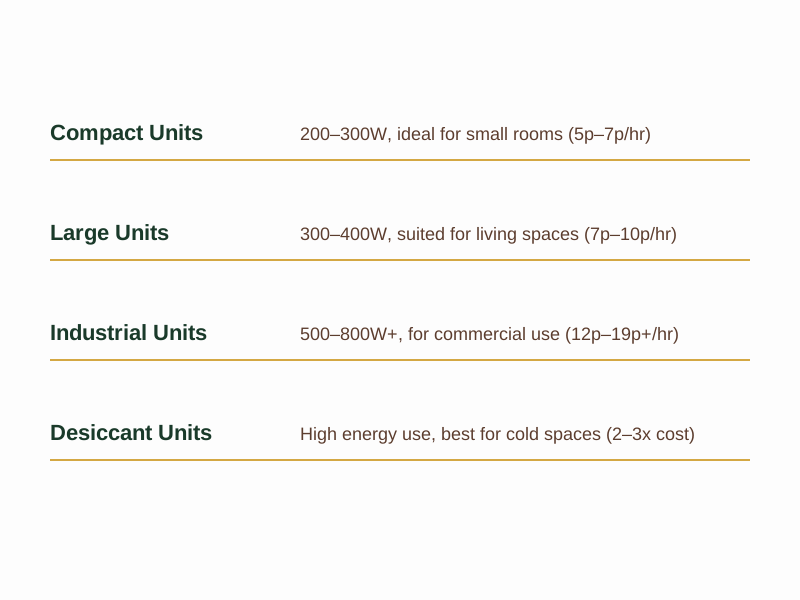
| Unit Type | Power Draw | Hourly Cost (approx) | Best For |
|---|---|---|---|
| Compact (12L) | 200–300W | 5p–7p | Small bedrooms, bathrooms |
| Large (20L) | 300–400W | 7p–10p | Living rooms, larger flats |
| Industrial | 500–800W+ | 12p–19p+ | Warehouses, commercial spaces |
| Desiccant | High (heating) | 2–3x compressor | Very cold, unheated rooms |
Based on 24p per kWh and typical UK usage patterns.
Taking the Next Step
A dehumidifier is not the default answer for every damp problem — but if condensation is the issue, which it is for the majority of UK homes, running costs are genuinely modest and the case for prevention is strong. The figure that matters isn’t the hourly cost in isolation: it’s the comparison between roughly £40 a year and several hundred pounds in repair costs if the mould takes hold.
Before buying, it is worth confirming that condensation is actually what’s driving your problem — not a leak, not rising damp, not a ventilation issue that a different fix would solve faster. That is the honest first step.
Now you know what the running costs actually look like — get the Free Damp & Mould Diagnosis Checklist to work out whether a dehumidifier is the right tool for your situation, or whether something simpler would do the job.
Related Guides
For a complete overview, see our Do You Actually Need a Dehumidifier? When It Helps and When It Doesn’t .
Sources & Further Reading
Note: Running costs are estimates based on typical UK electricity tariffs and appliance usage. Always verify specific device specifications and energy ratings before purchase.