Compressor vs Desiccant Dehumidifier: Which Works in a Cold UK House
As an Amazon Associate we earn from qualifying purchases. Some links on this page are affiliate links, which means we may earn a small commission if you make a purchase.
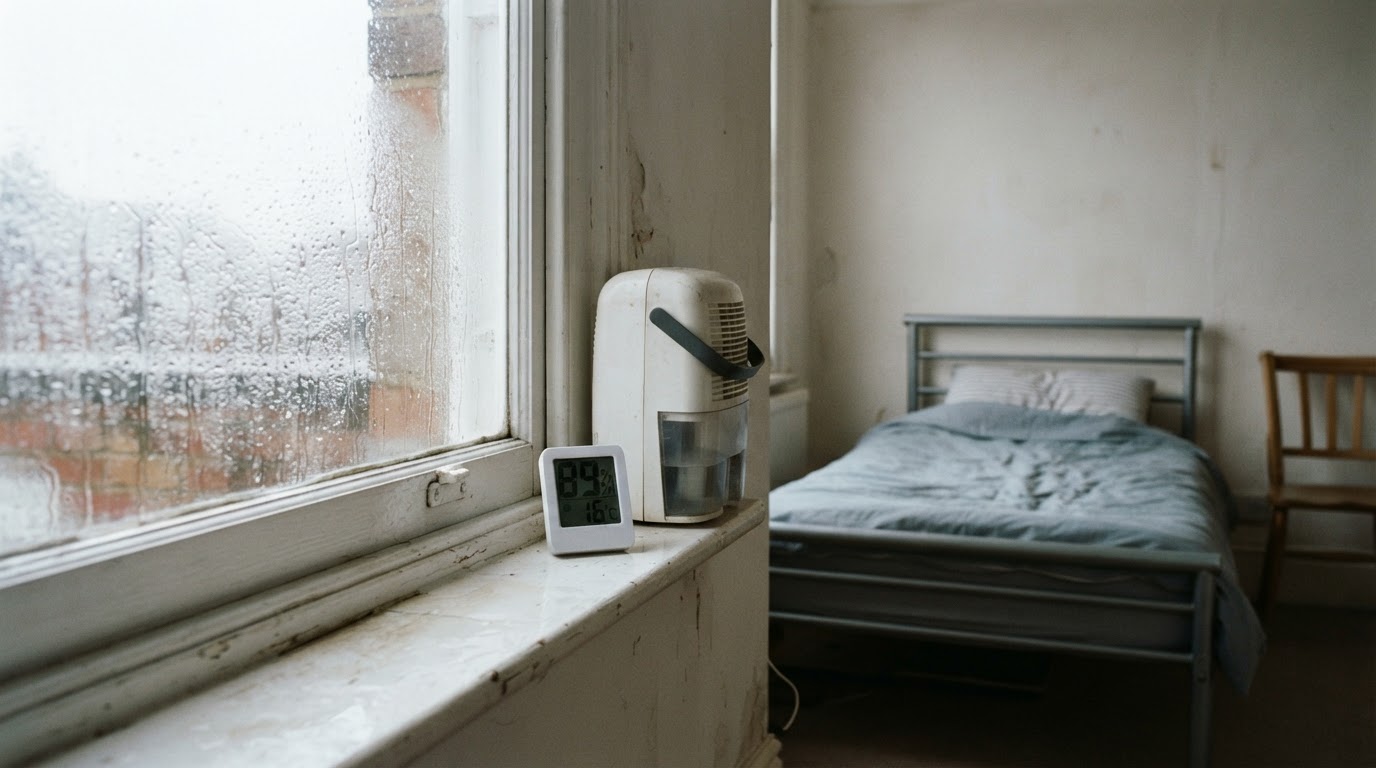
Waking up to condensation streaming down the bedroom window in January is a familiar experience for many UK homeowners. Our reader, Sarah, has exactly this—a cold spare room that sits around 10°C through winter, with black mould creeping back no matter how much she scrubs. She’s ready to buy a dehumidifier, but she’s just discovered there are two completely different types, and she’s not sure which one will actually work in a room that cold. That is the wrong moment to discover you’ve bought the wrong machine.
This article explains why the two technologies behave differently at low temperatures, provides a quick decision guide, and grounds the advice in what actual UK owners report. No fluff, no agenda—just the honest answer for a cold UK house.
How Dehumidifiers Actually Work
There are two fundamentally different ways to pull moisture from the air, and they behave very differently depending on the room temperature.
Compressor dehumidifiers work like a small refrigerator. A fan draws room air over a cold coil; the air cools, moisture condenses into water droplets, and the now-dry air reheats and blows back into the room. It is the same principle as the water dripping from an air conditioning unit, though the water collects in a tank rather than draining away. The efficiency of this process depends directly on how cold that coil can get, which in turn depends on the warmth of the incoming air.
Desiccant dehumidifiers work more like a sponge. A slowly rotating wheel coated in a hygroscopic material—silica gel—absorbs moisture directly from the air. Once the silica gel is saturated, a separate heating element warms it, driving the moisture out as water vapour to be collected or vented. The wheel rotates continuously, so one side absorbs while the other dries out. Crucially, this process does not require cold air; the silica gel can pull moisture from the air at any temperature, even in a freezing garage.
| Compressor | Desiccant | |
|---|---|---|
| How it works | Cools air to condense moisture | Absorbs moisture with silica gel rotor |
| Needs warmth to work efficiently | Yes | No |
| Electricity consumption | Lower (~200W) | Higher (~600W) |
| Weight | Heavier | Lighter |
The practical takeaway is straightforward: compressor units are like air conditioners—they need a warm room to perform well. Desiccant units are more like sponges that happen to need a heating element to wring themselves out.
The Temperature Trap in UK Homes
Here is where many UK buyers trip up. Compressor dehumidifiers are tested and rated in conditions around 20°C—a warm living room. In a British winter, an unheated spare room, a poorly insulated bedroom, or a garage can easily sit at 5–10°C. Below roughly 10°C, a standard compressor unit starts to struggle.
The reason is physics. The cold coil inside a compressor dehumidifier can only get so much colder than the incoming air. In warm conditions the coil might reach -5°C, which condensates moisture efficiently. In a 5°C room, the coil might only reach 0°C—marginal at best—and below that point, some units will simply shut down rather than ice up completely. The moisture removal rate falls off a cliff, and the machine may as well be running a small fan.
Desiccant units do not have this problem. Because they absorb moisture chemically rather than thermally, they work at any temperature. Most manufacturers recommend desiccant models for rooms below 15°C, and for genuinely cold spaces—garages, conservatories, outbuildings—they are often the only option that will extract any moisture at all.
Sarah’s situation is a good example: her spare room sits at 10°C through winter. A standard compressor unit would be operating at the edge of its capability, if not below it entirely. That is the difference between a machine that pulls half a litre of water a day and one that pulls five.
Before buying, confirm what you are dealing with. If the cold room has visible damp patches that do not shift with heating or ventilation, or if you are seeing signs of penetrating damp, our free damp and mould diagnosis checklist walks through the key questions to ask before you choose a machine.
The Verdict: Which Dehumidifier Should You Buy?
This is where most comparison articles list pros and cons and leave you to figure it out. We do things differently. Here is the honest call:
For most UK homes—rooms that are heated to 15°C or above in winter—a compressor dehumidifier is the right choice. It removes more moisture per kilowatt-hour, is cheaper to run, and will handle a typical UK spare room, living room, or bedroom without any problem.
Desiccant units are the right choice in one specific situation: when the room you are treating is consistently below 12°C, or when you need near-silent operation. In an unheated garage, a cold loft room, a boat, a caravan, or a Victorian terrace bedroom that refuses to warm up, a compressor unit will underperform or fail. A desiccant machine will keep pulling moisture regardless.
The trade-off is real: desiccant units use more electricity. A typical compressor draws around 200W; a typical desiccant draws around 600W—three times as much—because that heating element runs almost continuously to regenerate the silica gel rotor. In a cold room where a compressor would barely work, the desiccant earns its keep. In a 19°C living room, the desiccant is spending three times the electricity to remove the same amount of moisture.
UK testing has found compressor dehumidifiers use 40–60% less electricity than desiccant units at normal room temperatures—a meaningful difference when you are running the machine for eight or ten hours a day through a British winter.
The quick call:
- Room above 15°C? Buy a compressor unit. More efficient, cheaper to run, removes more moisture per kWh.
- Room below 12°C, or unheated? Buy a desiccant unit. It will actually work when the compressor can’t.
- Heated living spaces, mild to moderate condensation? Compressor. Every time.
- Unheated garage, boat, or caravan? Desiccant. Non-negotiable.
Owners report the same pattern: a compressor unit that works beautifully in the living room is essentially useless in the cold spare room. The solution is to match the technology to the temperature.
Real-World Performance and Noise
Beyond the temperature question, there are a few practical differences worth knowing.
Noise is the most commonly cited complaint with compressor units. The compressor produces a low, droning hum—similar to a fridge. On lower fan speeds it is manageable, but in a quiet bedroom at night, some owners find it noticeable. Desiccant units are generally quieter because there is no compressor—just a fan and the soft hiss of the rotor. That said, when a desiccant unit is in “drying mode,” it can introduce a warmer, fan-like noise. The consensus across UK owner reviews is that desiccant units win on quietness overall, but it is not a clean sweep.
Tank size and maintenance are similar between the two types. A few owners have noted that desiccant units sometimes have smaller tanks, which matters if you are running the machine continuously overnight. Connecting a drain hose is an option on most models, which removes the emptying chore entirely.
Durability tends to favour compressor units. They are essentially a sealed refrigerant system—the same technology as a fridge—and tend to be robust over many years. Desiccant units have more moving parts (the rotating wheel) and a heating element that operates continuously, which can mean more to go wrong. The units are generally lighter and easier to move, however.
The honest summary from what UK owners report: compressor units are workhorses—reliable, efficient, and a bit noisy. Desiccant units are quieter and more versatile in cold conditions, but they cost more to run and may not last as long under heavy use. Neither is objectively better; the right choice matches your room’s temperature.
Top Picks for UK Homes
Based on the verdict above and real owner feedback, here are the machines worth considering. Prices are approximate—check current listings for the most recent cost.
Best overall compressor for most UK homes: Ebac 2650e (paid link) The British-made option that comes up repeatedly in UK owner reviews. Buyers praise its quiet operation for a compressor unit, its effective moisture removal, and its reliability. It sits at a higher price point, and the control panel can feel fiddly to set up. But for a room that is genuinely heated, it does the job without drama.
Best for cold rooms: Meaco Arete One 12L (paid link) This desiccant model is consistently praised by UK buyers for being effective in rooms where a compressor would struggle and for its surprisingly quiet operation. The laundry mode is useful for damp flats, though some owners find it does not run long enough for heavy drying loads. It is not cheap, but for a cold spare room where a compressor would fail, it is worth the investment.
Best budget compressor: EcoAir DC12 (paid link) A practical, affordable choice for milder damp problems and regular laundry drying. Owners report it pulls moisture effectively and is easy to use, with castors for moving between rooms. The trade-offs are real: it is noisier than premium models, and the water tank design can feel awkward to empty. At a lower price point, it delivers the core function for smaller flats or less severe condensation problems.
Best budget cold-room option: Pro Breeze 10L The desiccant model that comes up for unheated garages, cold cellars, and spaces where temperatures drop close to freezing. Owner reviews confirm it works down to around 1°C—a claim that matches its desiccant technology. The catch with budget desiccants is the running cost: the heating element draws power consistently, and the smaller tank means more emptying. If you need a machine that will actually work in a freezing garage, this is the honest budget option.
Frequently Asked Questions
Can I use a dehumidifier in a freezing garage?
Yes, but only a desiccant model. Compressor units will struggle below 10°C and may not extract any moisture at all in a freezing garage. A desiccant unit will keep working, though it will use more electricity.
Which is quieter: compressor or desiccant?
Desiccant units are generally quieter because they do not have a compressor motor running continuously. That said, the difference narrows on lower fan settings, and some desiccant units can feel noisy when the heating element kicks in during the regeneration cycle. For a bedroom where silence matters, desiccant is typically the better choice.
Do dehumidifiers use a lot of electricity?
Compressor units are significantly more efficient—a good compressor model uses roughly half the electricity of a desiccant unit for the same amount of water removed. Running a compressor dehumidifier for eight hours a day through winter typically costs a few pounds a week at current UK energy prices, which most owners find acceptable. Desiccant units cost more to run but will actually work in conditions where a compressor will not.
Can I leave a dehumidifier on all day?
Yes. Most modern units are designed for continuous use, and for persistent condensation or damp problems, leaving the machine running is often the right approach. Remember to empty the tank regularly, or connect a drain hose so the water drains away automatically. Many owners with ongoing damp problems run their machine on a hygrostat setting—it switches on and off automatically to maintain a target humidity level.
Will a dehumidifier stop mould?
It will reduce the moisture that mould needs to grow, which is a significant part of the solution. But a dehumidifier alone will not fix the underlying cause if you have poor ventilation, a persistent leak, or cold surfaces that condensation keeps forming on. Improving airflow, fixing moisture sources, and running the dehumidifier together will give you the best result—addressing the problem properly rather than just managing it.
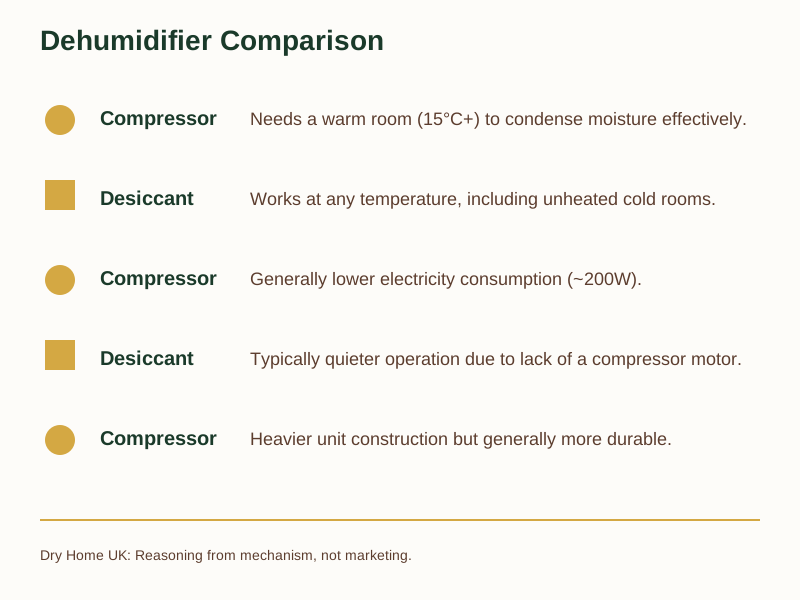
Dehumidifier Technology Comparison
| Feature | Compressor | Desiccant |
|---|---|---|
| How it works | Cools air to condense moisture | Absorbs moisture with silica gel rotor |
| Needs warmth | Yes | No |
| Electricity | Lower (~200W) | Higher (~600W) |
| Weight | Heavier | Lighter |
| Best for | Heated rooms (15°C+) | Cold rooms (below 12°C) |
Taking the Next Step
The honest summary is this: for most UK homes with heated rooms, a compressor dehumidifier is the more efficient and cheaper-to-run choice. Desiccant units are a specialist tool for cold spaces—unheated bedrooms, garages, boats—where a compressor simply will not perform.
The decision hinges on one question: what temperature is the room you are trying to treat? Answer that, and the choice is straightforward.
Before you buy, confirm whether the problem is actually condensation—which a dehumidifier can address—or whether there is something else going on, like a leak or poor ventilation that needs fixing first. That is exactly what our free damp and mould diagnosis checklist is designed to help with. It is a short set of questions that points you toward the right solution before you spend money on the wrong one.
Related Guides
For a complete overview, see our Do You Actually Need a Dehumidifier? When It Helps and When It Doesn’t .
Sources & Further Reading
As an Amazon Associate we earn from qualifying purchases.
Note: General guidance only, verify details with a qualified professional or official source.
See EcoAir DC12 on Amazon → (paid link)
See Meaco Arete One 12L on Amazon → (paid link)
View Ebac 2650e on Amazon → (paid link)