Awaab's Law Explained: What Tenants Need to Know
eBay Partner Network: I earn a commission when you buy through eBay links on this page.
As an Amazon Associate we earn from qualifying purchases. This page contains affiliate links — if you buy through them, we earn a small commission at no extra cost to you.
Awaab’s Law sounds like the solution every tenant dealing with damp and mould has been waiting for. In some ways, it is. But the honest answer most articles skip over is that Awaab’s Law currently only applies to social housing tenants — not private renters, not shared-ownership leaseholders, and not anyone whose landlord is a private individual or company. That matters because the UK private rental sector is larger than the social housing sector and continues to grow.
Before you stop reading, understand what the law actually does and — just as importantly — what routes exist for the large number of tenants it doesn’t cover. That distinction is the backbone of this article. By the end, you’ll know which legal framework applies to your situation, what your landlord is required to do, and the steps that genuinely move things forward.
What Is Awaab’s Law?
Awaab’s Law is named after Awaab Ishak, who was two years old when he died in December 2020. The cause of death was respiratory failure. The catalyst was severe mould in his family’s social home in Rochdale. It is a case that should never have happened, and the law has spent the years since trying to ensure it cannot happen again.
The law is built into the Social Housing Regulation Act 2023, which received Royal Assent in July 2023. It places specific, time-bound duties on social landlords — housing associations and local authority landlords — when a tenant reports damp or mould. These duties are not guidelines; they are enforceable.
The Housing Act 2004 already gave local authorities powers to intervene in poor housing conditions through the Housing Health and Safety Rating System (HHSRS), which can classify damp and mould as a Category 1 hazard. Awaab’s Law adds something more specific: a set of response timelines that apply directly to social landlords, giving tenants a clearer route to hold them to account.
The Timeframes — What Social Landlords Must Do
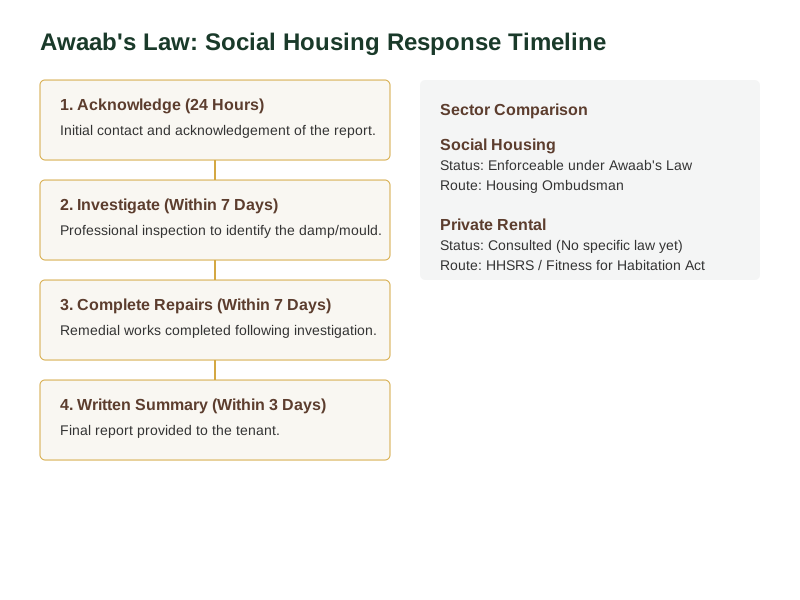
This is the section tenants need most, so it’s worth being exact. When a social tenant reports damp or mould, Awaab’s Law requires the landlord to:
- Acknowledge the report and make contact within 24 hours.
- Begin an initial investigation within 7 days.
- Complete the repair within a reasonable timeframe — typically around seven days for straightforward repairs, though gov.uk guidance allows for variation depending on the nature and complexity of the work.
The 24-hour window is fast, but the 7-day investigation window is arguably the more meaningful floor. It is the point at which the landlord must have genuinely looked at the problem and started forming a plan, rather than just sending an acknowledgement email.
The law also requires the landlord to provide a written summary of the investigation findings within three working days of completion. That summary is important: it creates a paper trail you can use if the work doesn’t happen, isn’t done properly, or takes too long.
These are minimum standards. A landlord who acts more quickly isn’t breaking any rules — but one who does less is.
What If the Landlord Doesn’t Comply?
The enforcement route for social tenants is a strength of Awaab’s Law, though it requires patience. The sequence runs roughly as follows:
- Use the landlord’s own complaints procedure first. Every registered social landlord must have one. If they don’t respond within their published timescales, or if the response is inadequate, move to the next step.
- Escalate to the Housing Ombudsman. The Housing Ombudsman handles complaints against member social landlords. The service is free. It can investigate, make findings, and order the landlord to take specific action — including apologies, financial compensation, and practical remedies. The Ombudsman can also name the landlord publicly in its decisions, which matters to housing associations with reputational concerns.
- In serious cases, the local authority has powers. If the damp or mould constitutes a Category 1 hazard under HHSRS, the local authority housing team can serve an enforcement notice on the landlord. This is not automatic and tends to be used for the most severe cases, but the power exists.
The honest gap here is time. Awaab’s Law sets timelines for the landlord to act, but it doesn’t set a hard timeline for the Ombudsman to complete an investigation. The process can take months. Tenants in severe conditions — particularly those with children, elderly residents, or anyone with a respiratory condition — should flag this to the council’s environmental health team alongside any complaint through the landlord’s own system.
Private Tenants: The Route Exists, But It’s Different
Here is the part of the story every private tenant needs to understand: Awaab’s Law does not currently apply to private rentals.
This is not a minor caveat; it is the central fact of the law’s current scope. Social landlords are covered. Private landlords are not.
Private tenants dealing with damp and mould have two main routes instead:
The Homes (Fitness for Habitation) Act 2018 requires landlords to ensure their property is fit for human habitation at the start of and throughout a tenancy. Damp and mould that makes a home unsafe or unhealthy can constitute a breach of this duty. A tenant can bring a claim in the courts if the landlord fails to address it. In practice, this route is slower and less structured than Awaab’s Law, and it requires the tenant (or their adviser) to do more of the work themselves.
The local authority’s HHSRS powers apply regardless of tenure. If damp and mould in a private rented home reaches the level of a Category 1 hazard, the council can act. The problem is that local authority housing teams are stretched, and enforcement action is not guaranteed.
There is a third piece of context: the government ran a consultation on extending Awaab’s Law to the private rented sector, which closed in early 2024. As of now, no legislation has been enacted to bring private rentals within scope. This is worth watching, but for now, the protection is real only for social tenants.
Supported accommodation providers fall somewhere in between. Some are registered social landlords and are covered by Awaab’s Law in full. Others are not. Tenants in supported housing should check their provider’s registration status before assuming the 24-hour and 7-day timeframes apply.
The Honest Practical Gap — What Tenants Do While Waiting
Legal timescales are important, but they don’t stop mould from growing in the meantime. Tenants in any tenure waiting for a landlord to act have a limited but real set of options:
Ventilation matters. Opening a window for ten minutes a day, using extractor fans when cooking or showering, and leaving internal doors open to allow air circulation all reduce moisture in the home. This won’t solve structural damp, but it does reduce the conditions that allow surface mould to establish and spread.
Report everything in writing, every time. A phone call is not documentation. An email or letter creates a record that proves the landlord was told and when. This matters for Awaab’s Law compliance and for any future complaint or legal action. Screenshot and save everything.
For surface mould on walls, tiles, or sealant — not structural damp — a mould treatment spray can be used while waiting for repairs. Products like HG Mould Remover (paid link) or Dettol Mould & Mildew Remover (paid link) (sold as a 3-pack) will clear visible growth, though this is cosmetic. Owners who use these products consistently report the bleach smell is strong and good ventilation is essential. The mould will return if the underlying moisture problem isn’t fixed; treating the surface while the wall stays damp is papering over the cracks.
A hygrometer — a device that measures humidity — can help tenants monitor whether conditions are improving. The ThermoPro TP50 (paid link) is a straightforward, reliable model that owners frequently recommend, with a clear display and no complicated setup. The Brifit Digital Hygrometer (paid link) (sold as a 2-pack) is a cheaper alternative with Bluetooth connectivity, though some owners report batteries need replacing more often than expected. Neither will fix damp, but both provide objective data to include in your written reports. If cost is the deciding factor, a generic digital hygrometer (eBay paid link) from eBay does the same basic job for a few pounds — you’re not filing evidence for a lab, you just need a number to put in your written report.
See current price on Amazon → (paid link)
The Honest Call
If you’re in social housing and your landlord has failed to respond within the timeframes set out in Awaab’s Law, you have a clear, named, enforceable route. The Housing Ombudsman is the right next step, and you should be building your paper trail now.
If you’re in a private rental, Awaab’s Law does not apply to you yet. The Homes (Fitness for Habitation) Act gives you a route, and the council’s environmental health team is the other lever worth pulling. But be realistic about the timescales and the effort involved. This is where private tenants feel the difference most: the protection exists, but the mechanism for enforcing it is less automatic and less fast.
The one thing that moves every route forward is written documentation from the start. Whatever your tenure, a paper trail is the foundation of every successful complaint.
Now you know what applies to your situation — Get the Free Damp & Mould Diagnosis Checklist to record what you’re seeing and what you’ve reported, so nothing gets lost.
Awaab’s Law: Social vs Private Tenants
| Feature | Social Housing | Private Rental |
|---|---|---|
| Scope | Covered by Awaab’s Law | Not covered by Awaab’s Law |
| Primary Route | Housing Ombudsman | Homes (Fitness for Habitation) Act 2018 |
| Enforcement | Local authority powers | Local authority HHSRS powers |
| Timeline | 24-hour acknowledgement | No fixed timeline |
| Status | Enforceable | Consultation closed, no legislation yet |
Frequently Asked Questions
Does Awaab’s Law apply to all types of damp and mould?
Awaab’s Law covers damp and mould that constitutes a hazard in the home — in practice, the kind of persistent, visible mould that a landlord should reasonably be aware of and able to address. It does not cover every minor condensation issue that might occur in a well-used bathroom. The more persistent, widespread, or severe the problem, the more clearly it falls within scope.
How do I contact the Housing Ombudsman?
You can make a complaint through the Housing Ombudsman’s website at housing-ombudsman.org.uk. Before you escalate to them, you must have exhausted your landlord’s own complaints procedure — the Ombudsman will not accept a case until you’ve done that first.
What counts as a “reasonable timeframe” for repairs?
Gov.uk guidance indicates that straightforward repairs should typically be completed within seven days of the investigation being completed. More complex work — anything involving structural issues, multiple trades, or works that need planning consent — may legitimately take longer. What isn’t acceptable is indefinite delay without communication. If your landlord goes quiet after the initial 7-day investigation window, that silence is itself something to challenge.
I rent privately — should I just wait for Awaab’s Law to be extended?
Waiting is not a strategy. The government’s consultation on extending Awaab’s Law to private rentals closed in early 2024, and no legislation has followed. In the meantime, your current routes are the Homes (Fitness for Habitation) Act and your local council’s environmental health team. Use them now.
My landlord says the mould is my fault for not ventilating — is that a valid defence?
Not entirely. Landlords have a duty to keep a property in repair and free from damp that stems from the structure or fabric of the building. Tenants have a responsibility to use ventilation and heating sensibly, and chronic condensation caused by drying clothes indoors with no ventilation can be attributed in part to tenant behaviour. But a landlord cannot use tenant behaviour as a complete defence when there are underlying structural issues — a cold north-facing wall that gets damp regardless of how often you open a window is not your fault.
Related Guides
For a complete overview, see our Landlord Responsibilities for Damp and Mould: What UK Law Says .
Sources & Further Reading
As an Amazon Associate we earn from qualifying purchases.
Note: This information is for general guidance only. Always verify details with a qualified professional or official source.
Buy Brifit Digital Hygrometer on Amazon → (paid link)
View Dettol Mould & Mildew Remover on Amazon → (paid link)
View HG Mould Remover on Amazon → (paid link)